

Sapphire FUE is a refinement of the standard Follicular Unit Extraction technique in which the surgeon opens the recipient channels using blades made from synthetic sapphire crystal rather than conventional stainless steel. The extraction of individual follicular units stays essentially the same, but the sharper, smoother edge of the sapphire blade allows for smaller, more precise incisions. For patients researching a hair transplant in Turkey, understanding this distinction matters because channel creation directly influences graft survival, final density, healing time, and how natural the hairline ultimately looks. This guide explains what Sapphire FUE actually is, how it differs from classic steel-blade FUE, where its real advantages lie, and how it compares to DHI, so you can have a more informed conversation with your surgeon.
Key Takeaways
- Sapphire FUE is not a different transplant method but a variation of classic FUE that uses sapphire crystal blades instead of steel to open the recipient channels.
- The main practical benefits are smaller and smoother channels, which can allow denser packing, reduced swelling, less scabbing, and often faster surface healing.
- The graft extraction stage is identical to standard FUE; only the channel-opening instrument changes, so results still depend heavily on surgeon skill.
- Sapphire FUE and DHI are different tools for different situations — sapphire suits large sessions and defined hairlines, while DHI can excel in targeted density work.
- At Hairvard, planning is individualized; the blade type is one factor among many, alongside graft count, angle, and direction.
- Typical Sapphire FUE pricing in Turkey sits within the EUR 2,200 to 4,800 range depending on graft numbers and case complexity.
What Is Sapphire FUE?
Sapphire FUE describes a Follicular Unit Extraction procedure in which the recipient-site incisions are created with blades ground from lab-grown sapphire, one of the hardest known materials after diamond. In any FUE hair transplant, the process has three broad stages: harvesting individual follicular units from the donor area, opening tiny channels in the recipient area, and placing the grafts into those channels. Sapphire FUE changes only the middle stage — the tool used to open the channels.
The blades are typically shaped as fine points or narrow V-shaped tips in sizes ranging from roughly 0.7 mm to 1.5 mm. Because sapphire holds an extremely sharp, uniform edge, the surgeon can make cleaner incisions with less tissue trauma than a comparatively duller steel blade produces over the course of thousands of channels. This is the entire technical basis for the marketing term "Sapphire FUE." It is important to be honest here: the sapphire blade is an instrument, not a separate surgical philosophy. To understand where it fits, it helps to first review what a hair transplant involves as a whole.
The term became popular partly because it is easy to market, but the underlying benefit is genuine when the tool is used by an experienced team. A sharp, precise blade in unskilled hands does not produce a better result, and a skilled surgeon can achieve excellent outcomes with steel. The blade improves the ceiling of what is achievable; it does not replace expertise.
Sapphire Blades vs Steel Blades
The core difference between Sapphire FUE and classic FUE is the material and geometry of the blade used to open recipient channels. Steel blades have been the standard for decades and remain perfectly capable in trained hands. Sapphire blades offer measurable edge advantages that translate into subtle clinical differences.
| Feature | Sapphire Blade | Steel Blade |
|---|---|---|
| Material | Lab-grown sapphire crystal | Surgical stainless steel |
| Edge sharpness | Extremely sharp, retains edge longer | Sharp, dulls faster with repeated use |
| Channel smoothness | Smoother incision walls | Slightly rougher walls |
| Incision size | Very fine, can be narrower | Fine, standard |
| Tissue trauma | Lower per channel | Slightly higher |
| Reuse | Single-use per procedure | Single-use per procedure |
| Cost of instrument | Higher | Lower |
The practical consequence of a smoother, narrower channel is that surrounding tissue is disturbed less. Smaller wounds tend to close and crust over faster, which is why many patients report less visible scabbing and reduced swelling with sapphire blades. Because the channels can be placed closer together without tearing tissue, the surgeon has more freedom in dense-packing areas that need visual fullness, such as the frontal hairline.
However, these advantages are incremental rather than transformational. The difference between a good steel-blade result and a good sapphire result, judged at twelve months, is often modest. What matters far more is how accurately each channel is angled and directed — something the blade cannot decide on its own.
Advantages of Sapphire FUE
The genuine, defensible benefits of sapphire blades cluster around precision and healing. Below are the advantages most consistently observed, with honest context on how meaningful each one is in practice.
Smaller and Smoother Channels
The sharpest, most uniform edge produces incisions with clean walls and minimal surrounding damage. Cleaner channels mean the graft sits more snugly, which can support better initial anchoring and reduce the chance of grafts popping out during the early hours after placement.
Denser Packing Potential
Because narrower channels can sit closer together, the surgeon can, in appropriate cases, increase the number of grafts per square centimeter. This matters most for the frontal zone and hairline, where density drives the perception of a full result. Dense packing must still respect blood supply — packing too tightly can compromise graft survival — so this is a potential, not an automatic gain.
Faster Surface Healing and Less Swelling
Smaller wounds generally crust and heal at the surface more quickly. Many patients notice reduced forehead swelling and shorter visible scabbing periods, which can shorten the socially sensitive recovery window by a few days.
Reduced Risk of Tissue Damage
Lower trauma per channel theoretically preserves more of the recipient area's delicate vascular network, which is essential for feeding the transplanted follicles.
| Advantage | What It Helps | Realistic Impact |
|---|---|---|
| Smoother channels | Graft fit and anchoring | Moderate |
| Dense packing | Frontal density | Case-dependent |
| Faster healing | Recovery comfort | Modest to moderate |
| Less swelling | Early appearance | Modest |
| Lower tissue trauma | Graft survival environment | Supportive, not decisive |
It is worth stating plainly: no blade guarantees a result. Anyone promising a specific graft-survival percentage purely because of a sapphire blade is overselling the technology.
The Sapphire FUE Procedure Step by Step
Understanding the sequence helps set realistic expectations. A Sapphire FUE session at a licensed clinic generally follows the same arc as standard FUE, with the channel stage using sapphire tips.
| Stage | What Happens | Approximate Time |
|---|---|---|
| Consultation and planning | Hairline design, graft estimate, donor assessment | 30–60 min |
| Local anesthesia | Numbing donor and recipient areas | 20–30 min |
| Graft extraction | Harvesting follicular units one by one with a micromotor punch | 2–4 hours |
| Channel opening (sapphire) | Creating recipient incisions with sapphire blades at correct angle and depth | 1–2 hours |
| Graft placement | Implanting grafts into the channels | 2–3 hours |
| Aftercare briefing | Washing instructions, medication, follow-up plan | 20–30 min |
The full procedure usually spans a single long day, often six to eight hours depending on graft count. The extraction stage is where sapphire changes nothing; the channel stage is where its precision is applied. Angle, direction, and density are decided by the surgeon in real time, which is why the operator's judgment outweighs the instrument.
After surgery, the recipient area shows tiny crusts that typically flake away within seven to fourteen days. The transplanted hairs shed within the first month — this is normal shock loss — and new growth begins around months three to four, with meaningful results at six to nine months and final density near twelve to eighteen months.
Who Is Sapphire FUE Suitable For?
Sapphire FUE is a strong general-purpose choice, but it is not universally superior. It tends to suit specific patient profiles particularly well.
- Patients needing large sessions. When thousands of channels must be opened, the durable, consistent sapphire edge maintains precision across the whole session.
- Those prioritizing a defined, dense hairline. The dense-packing potential is most valuable at the front.
- Patients with sensitivity to swelling or slow healing. The reduced trauma can make recovery more comfortable.
- People who want a shaved or short-cut procedure. Classic sapphire FUE usually involves shaving the recipient and donor areas for access.
Sapphire FUE may be less ideal for patients who specifically want an unshaven approach in limited areas, where DHI or a hybrid method can be more convenient. It also cannot overcome an inadequate donor area — no technique creates hair where follicles do not exist. A proper consultation determines candidacy far better than a blade preference. If you are weighing your options, our comparison of FUE versus DHI is a useful next read.
Sapphire FUE vs DHI: How They Compare
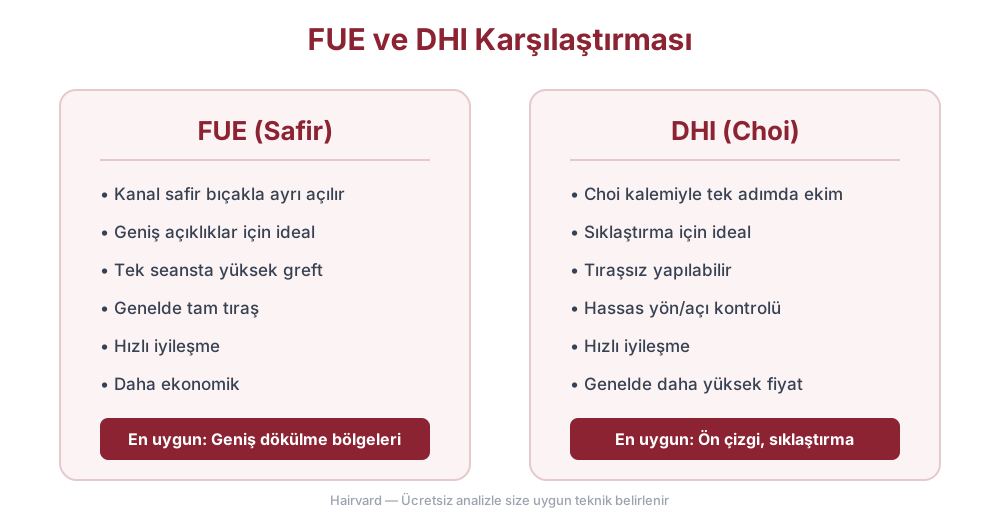
DHI (Direct Hair Implantation) and Sapphire FUE are frequently pitched against each other, but they are not opposites. The key structural difference is that Sapphire FUE separates channel-opening and graft-placement into two steps, while DHI combines them using a Choi implanter pen that opens the channel and places the graft in a single motion.
| Factor | Sapphire FUE | DHI |
|---|---|---|
| Channel and placement | Two separate steps | Combined in one motion |
| Main instrument | Sapphire blade + forceps | Choi implanter pen |
| Dense packing | Very good | Excellent in targeted zones |
| Unshaven option | Less common | More feasible |
| Best for | Large areas, full hairline | Precision density, specific zones |
| Session length | Long | Often longer |
| Learning curve | Moderate | Steeper for the team |
| Typical cost | Standard | Often slightly higher |
Neither method is inherently "better." DHI can allow tighter control over depth and direction at placement, which some surgeons prefer for the hairline, while Sapphire FUE offers efficiency and excellent results across large recipient areas. Many clinics, including experienced teams in Turkey, use both and select based on the individual case — or even combine techniques within one procedure. The instrument should follow the plan, not the other way around.
Sapphire FUE Cost in Turkey
Turkey has become a leading destination for hair transplantation because it combines experienced surgeons, high patient volume, and favorable pricing. Sapphire FUE in Turkey typically falls within a transparent range rather than a single fixed number, because the final figure depends on graft count, case complexity, and the clinic's inclusions.
| Package Element | Commonly Included | Notes |
|---|---|---|
| Surgeon and team fees | Yes | Core of the price |
| Sapphire blades and consumables | Yes | Single-use instruments |
| Anesthesia | Yes | Local |
| Post-op medication and kit | Usually | Shampoo, lotion, sprays |
| Hotel accommodation | Often | Varies by package |
| Airport transfers | Often | Varies by package |
| Follow-up support | Yes | Ongoing aftercare guidance |
At Hairvard, Sapphire FUE generally sits within the EUR 2,200 to 4,800 range. The variation reflects the number of grafts required and the individual complexity of each case, not hidden upsells. Be cautious of prices that seem far below market — extremely low quotes can signal high-volume, low-supervision operations. For a fuller breakdown of what drives pricing, see our guide to hair transplant cost in Turkey.
A realistic budget conversation should always follow a personalized graft estimate. Two patients with the same goal can need very different graft numbers, and the graft count is the single biggest driver of cost.
Making the Right Choice
Choosing between Sapphire FUE, classic FUE, and DHI should never come down to a marketing label. The blade is a means to an end; the end is natural, durable, correctly angled hair growth that suits your face. A trustworthy clinic will start with your donor assessment, your degree of hair loss, and your goals, then recommend a technique — or combination — that fits. If a provider leads with the instrument rather than your individual plan, treat that as a warning sign.
The most reassuring signals are a licensed facility, a surgeon who explains trade-offs honestly, realistic expectations about timelines, and a written plan you understand. Sapphire FUE is an excellent, well-proven refinement of FUE, and in skilled hands it delivers clean, dense, natural-looking results — but it earns those results through planning and execution, not the blade alone.
Frequently Asked Questions
Is Sapphire FUE better than classic FUE?
Sapphire FUE offers incremental advantages over classic steel-blade FUE, mainly smoother channels, potential for denser packing, and often faster surface healing. However, both can produce excellent results in experienced hands. The blade improves precision but does not replace surgical skill, which remains the decisive factor.
Does Sapphire FUE hurt more than regular FUE?
No. Both procedures are performed under local anesthesia, so you should feel little to no pain during surgery. Because sapphire blades create smaller, cleaner channels, many patients actually report slightly less post-operative discomfort and swelling compared with standard FUE.
How long does recovery take after Sapphire FUE?
Surface crusts usually flake away within seven to fourteen days. Most patients return to non-strenuous work within a few days. Redness fades over one to three weeks. The transplanted hairs shed within the first month, and visible new growth begins around months three to four.
Will Sapphire FUE leave scars?
Like all FUE methods, Sapphire FUE leaves tiny dot-like scars in the donor area that are generally not visible once hair grows to a short length. There is no long linear scar as with older strip-harvesting techniques. The recipient channels heal without noticeable scarring.
How many grafts can be done with Sapphire FUE?
This depends on your donor capacity, not the blade. Many sessions range from around 2,000 to 4,500 grafts in a single day. Your surgeon determines a safe maximum based on donor density and the size of the area to be covered during your consultation.
Is Sapphire FUE suitable for women?
Yes. Sapphire FUE can be appropriate for female patients, particularly where a defined hairline and controlled density are desired. Candidacy depends on the pattern and cause of hair loss, so a specialist assessment is essential before recommending any technique.
Can Sapphire FUE be done without shaving my head?
Classic Sapphire FUE usually requires shaving the donor and recipient areas for access and precision. Fully unshaven procedures are more commonly associated with DHI or specialized hybrid approaches. Discuss unshaven options with your clinic if this is a priority for you.
How is Sapphire FUE different from DHI?
Sapphire FUE opens channels and places grafts in two separate steps using a sapphire blade and forceps. DHI combines both steps using a Choi implanter pen. DHI can offer more control in targeted zones, while Sapphire FUE is efficient across large recipient areas.
Does the sapphire blade guarantee a higher graft survival rate?
No honest clinic can guarantee a specific survival percentage based on the blade alone. Smoother channels create a favorable environment for grafts, but survival depends on extraction quality, time out of the body, placement skill, and your aftercare compliance.
Is Sapphire FUE more expensive than classic FUE?
It can be marginally more expensive because sapphire blades cost more than steel, but the difference is usually small within a full package. At Hairvard, Sapphire FUE falls within the EUR 2,200 to 4,800 range depending on graft count and case complexity.
How long does a Sapphire FUE procedure take?
A typical session spans a single long day, usually six to eight hours depending on the number of grafts. This includes planning, anesthesia, extraction, channel opening, placement, and an aftercare briefing before you leave.
When will I see the final results of Sapphire FUE?
Early growth appears around months three to four. You will see meaningful improvement by six to nine months, and final density typically settles between twelve and eighteen months as the transplanted follicles mature and thicken.
Is Sapphire FUE permanent?
The transplanted follicles are usually taken from the donor area at the back and sides, which are genetically resistant to the hormone that causes pattern hair loss. These follicles generally continue to grow permanently, though non-transplanted native hair can still thin over time.
This article was medically reviewed and confirmed by Specialist Ibrahim Yilmaz at Hairvard, Atasehir/Istanbul, licensed by the Turkish Ministry of Health. For personalized guidance, we invite you to request a free hair analysis with our team to receive an individualized graft estimate and technique recommendation based on your own donor area and goals.