

Body Hair Transplant (BHT) is a specialized technique that harvests follicles from areas outside the scalp — most commonly the beard, chest, and other parts of the body — to supplement or, in select situations, substitute the traditional scalp donor region. For most people seeking hair restoration, the back and sides of the head remain the first and best source of grafts. But when years of extraction or advanced hair loss have left the scalp donor thin, BHT can extend what is possible by tapping into follicles that would otherwise go unused.
This article explains when BHT makes sense, how body and facial hair differ from scalp hair, and what realistic expectations look like. It is written to help you understand the trade-offs rather than to promise a specific outcome, because every donor area behaves differently and results depend heavily on individual biology.
Key Takeaways
- BHT uses non-scalp donor areas — primarily the beard, and secondarily the chest, abdomen, back, and limbs — to obtain follicles when the scalp donor is limited.
- It is a supplementary or salvage option, not a first-line choice. The scalp donor is almost always prioritized because its hair most closely matches the recipient scalp.
- Beard hair is the most valued body donor thanks to its caliber, density, and generally reliable growth, making it useful for density and certain recipient zones.
- Body and facial follicles differ from scalp hair in thickness (caliber), growth-cycle (anagen) duration, curl, and angle — all of which affect the final look.
- Candidacy is selective. Ideal cases involve depleted scalp donors, high graft demand, or a need for extra density in specific areas.
- Expectations must be realistic. Body hair typically stays shorter, may have a different texture, and graft survival can vary by donor site.
- A proper in-person evaluation is essential, including donor mapping and, ideally, a graft estimation to plan the procedure responsibly.
- BHT is technically demanding and should be performed only by experienced teams using FUE-based extraction tailored to each donor region.
What Is Body Hair Transplant (BHT)?
Body Hair Transplant refers to the use of Follicular Unit Extraction (FUE) to harvest individual follicles from areas of the body other than the classic scalp donor zone (the back and sides of the head). These follicles are then transplanted into areas of hair loss on the scalp — or occasionally into the beard, eyebrows, or scar tissue.
The most frequently used non-scalp donor is the beard, which many surgeons consider the "second donor area" because of its favorable characteristics. Beyond the face, follicles can sometimes be taken from the chest, upper back, shoulders, abdomen, and, less commonly, the arms or legs. Each of these regions has a distinct hair type, growth pattern, and extraction difficulty.
It is important to frame BHT correctly: it is rarely a stand-alone solution. In the vast majority of cases, it is combined with scalp grafts to reach a target graft count that the scalp donor alone cannot supply. Think of body hair as a way to extend the donor supply, not to replace the gold-standard scalp donor.
Why the Scalp Donor Comes First
The permanent scalp donor zone — the horseshoe-shaped band at the back and sides of the head — is prized for good reason. Hair from this region is genetically resistant to the effects of DHT (the hormone responsible for pattern hair loss), which is why it tends to keep growing even after transplantation. Just as importantly, its caliber, curl, growth cycle, and color usually blend seamlessly into the recipient scalp.
Body and facial hair, by contrast, evolved to do a different job. Chest hair, for example, has a shorter growth cycle and often a different curl, which changes how it looks once placed on the head. This is why surgeons exhaust the scalp donor's safe capacity before turning to body hair. BHT becomes relevant when:
- The scalp donor has been depleted by previous transplants.
- Native scalp donor density is naturally low relative to the size of the balding area.
- A large recipient area demands more grafts than the scalp can safely provide.
- Additional density is desired and the patient accepts the trade-offs of body hair.
How Body and Facial Hair Differ From Scalp Hair
Understanding tissue differences is central to setting expectations. Follicles from different regions vary across several measurable characteristics, and these differences dictate where a given graft is best used.
Caliber (thickness). Beard hair is often thicker than scalp hair, which can add visual density but may look coarse if placed at the hairline. Chest and body hair caliber varies widely between individuals.
Anagen (growth-phase) duration. Scalp hair has a long anagen phase, allowing it to grow many centimeters. Body hair has a shorter anagen phase, so it reaches a shorter terminal length. Transplanted body hair often retains its original, shorter growth tendency.
Curl and angle. Body and beard follicles frequently have more curl beneath the skin, which makes extraction more delicate and can affect how the hair lies once grafted.
Follicular grouping. Scalp follicles commonly grow in units of one to four hairs. Beard and body follicles are more often single-hair units, which can be an advantage for hairline refinement but means more extractions are needed for the same density.
| Characteristic | Scalp Donor | Beard | Chest / Body |
|---|---|---|---|
| Typical caliber | Medium | Thick | Variable (fine to medium) |
| Anagen duration | Long (grows long) | Moderate | Short (stays short) |
| Hairs per follicular unit | 1–4 | Mostly 1 | Mostly 1 |
| Curl below skin | Low–moderate | Moderate–high | Moderate–high |
| Blend with scalp hair | Excellent | Good (context-dependent) | Fair |
| Extraction difficulty | Standard | Higher | Higher |
Because of these differences, many surgeons use beard grafts to build density in the mid-scalp and crown — areas where a slightly coarser texture is less noticeable — while reserving finer scalp or single-hair grafts for the hairline itself.
Donor Area Comparison
Not all body donor sites are equal. Some offer better yield, easier extraction, or more scalp-compatible hair than others. The table below summarizes how the common donor regions compare in general terms. Individual anatomy can shift these rankings considerably.
| Donor Area | Relative Yield | Extraction Difficulty | Best Typical Use |
|---|---|---|---|
| Scalp (back/sides) | High | Standard | First-line donor for all zones |
| Beard (under-chin/neck) | Moderate–High | Moderate | Density in mid-scalp/crown, scar camouflage |
| Chest | Moderate | High | Supplemental density when scalp/beard limited |
| Upper back / shoulders | Low–Moderate | High | Additional volume in advanced cases |
| Abdomen | Low | High | Rarely used; case-by-case |
| Arms / legs | Low | Very High | Uncommon; last-resort supplementation |
The beard consistently ranks as the most useful non-scalp option. Extraction from the under-chin and upper-neck region tends to leave inconspicuous healing, and the grafts are robust. This overlap is also why patients interested in facial work sometimes explore a dedicated beard and eyebrow transplant rather than harvesting from the beard for the scalp.
Who Is a Candidate for BHT?
BHT is a selective procedure. It is best suited to people whose scalp donor cannot meet their restoration goals on its own, and who understand that body hair carries different characteristics. A thorough consultation is needed to assess donor supply across all regions, recipient demand, and the patient's expectations.
| Factor | Favorable for BHT | Less Favorable |
|---|---|---|
| Scalp donor status | Depleted or limited | Ample, untouched |
| Body/beard donor density | Good, healthy growth | Sparse |
| Recipient area size | Large, high demand | Small |
| Expectation of "long" hair from body grafts | Realistic (accepts shorter length) | Expects scalp-length growth everywhere |
| Prior transplant history | Multiple procedures, donor tapped | First procedure |
| General health | Suitable for FUE | Contraindications present |
Good candidates typically share a few traits: they have exhausted or nearly exhausted the scalp donor, they have healthy and reasonably dense beard or body hair, and they approach the procedure with realistic expectations. Patients whose scalp donor is still ample rarely need BHT and are usually better served by conventional scalp FUE.
The BHT Procedure: What to Expect
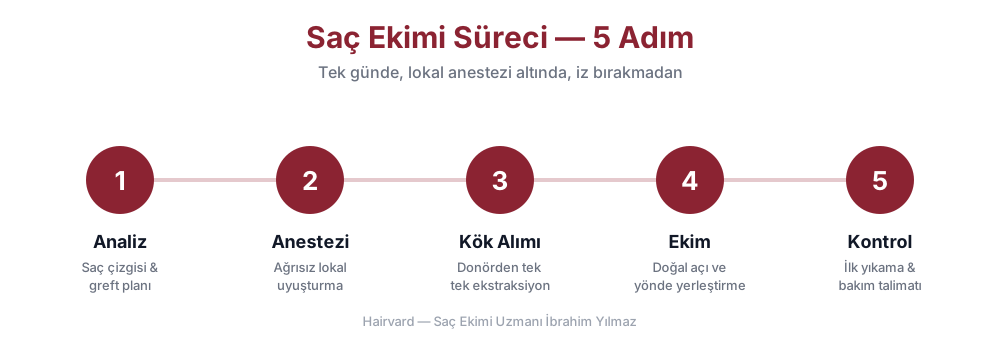
BHT is performed under local anesthesia using FUE. The surgeon extracts follicles one by one from the chosen body or facial region, then implants them into the recipient area much as with a standard scalp transplant. Because body and facial follicles often curve beneath the skin, extraction requires careful adjustment of punch size and angle to avoid transecting (damaging) the follicle.
Sessions may be longer than scalp-only procedures because non-scalp extraction is slower and more meticulous. In some plans, harvesting is staged across more than one session, especially when large numbers of grafts are needed or when multiple donor regions are used. Your surgeon may also combine scalp and body harvesting in a single session to reach the target count.
Healing at body donor sites is generally straightforward, with small dot-like marks that fade over time, similar to scalp FUE. As with any surgical procedure, aftercare instructions must be followed closely, and any medications should only be used under physician supervision.
If you are unfamiliar with the terminology used during consultations — terms like transection, anagen, or follicular unit — a quick read through a hair transplant glossary can make the planning conversation clearer.
Realistic Expectations and Limitations
Honesty about limitations is what separates a responsible BHT plan from an overpromised one. Body hair can genuinely expand donor supply, but it comes with trade-offs that every patient should weigh.
- Length. Body-derived hair usually keeps a shorter terminal length. It will not typically grow as long as scalp hair, which matters most in areas where long styling is desired.
- Texture. Coarser or curlier grafts can look different from surrounding scalp hair, so placement strategy matters.
- Variable survival. Graft survival rates from body sites can be less predictable than from the scalp and vary between donor regions and individuals.
- Multiple sessions. Because single-hair units dominate body donors, reaching high density can require more grafts and more time.
- No guarantees. Outcomes depend on individual biology, donor quality, and healing. No responsible clinic can promise a specific density or a certain result.
Framed correctly, BHT is a valuable tool for the right person: it can add coverage and density that would otherwise be impossible when the scalp donor is spent. Framed as a miracle fix, it will disappoint. The goal is meaningful improvement within the limits of the available tissue.
Cost Considerations
Pricing for hair restoration depends on the number of grafts, the complexity of the donor harvesting, and the number of sessions required. Because BHT extraction is slower and more technically involved than standard scalp FUE, procedures that rely heavily on body or facial donors can sit toward the higher end of a clinic's range. At Hairvard, hair transplant procedures generally fall within a range of €2,200 – €4,800, with the final figure determined after an in-person assessment of your donor areas and restoration goals.
A transparent quote should always follow a proper evaluation rather than precede it, because the graft count and donor strategy can only be finalized once your scalp and body donor supply have been mapped.
Frequently Asked Questions
Is body hair transplant as effective as a scalp transplant?
For most people, scalp-to-scalp transplantation gives the most natural and reliable results because scalp hair blends best with the recipient area. BHT is effective as a supplementary source when the scalp donor is limited, but body hair carries different characteristics that can affect the final look. It is best viewed as an extension of donor supply rather than an equal substitute.
Which body area is the best donor for BHT?
The beard is generally considered the best non-scalp donor because of its caliber, density, and relatively reliable growth. Chest hair is a secondary option, while the back, shoulders, abdomen, and limbs are used less frequently. The ideal choice depends on your individual hair characteristics, which a surgeon assesses during consultation.
Will transplanted body hair grow as long as scalp hair?
Usually not. Body and facial hair have a shorter growth (anagen) phase, so they tend to reach a shorter terminal length even after transplantation to the scalp. This is an important consideration if you plan to wear your hair long, and it is one reason body grafts are often placed where shorter length is acceptable.
Does harvesting beard hair affect my beard?
FUE extraction from the beard is done selectively to keep the donor area looking natural. When performed carefully, thinning in the beard is usually minimal and not obvious, especially when grafts are taken from the under-chin and upper-neck region. Your surgeon plans the harvest to preserve your beard's overall appearance.
Are the scars from body donor sites visible?
FUE leaves tiny dot-like marks rather than a linear scar. At body and facial donor sites these marks are typically small and fade over time, similar to scalp FUE. Visibility depends on your skin, hair density, and healing, all of which are discussed before the procedure.
Can BHT be combined with a regular scalp transplant?
Yes, and it very often is. In most plans, scalp grafts are used first and body or beard grafts supplement them to reach the desired graft count. Combining donor sources allows a larger total number of grafts than the scalp alone could safely provide.
How many grafts can be obtained from body hair?
This varies enormously between individuals based on body hair density and quality. Some patients have a substantial supplemental supply from the beard and chest, while others have relatively little. A personalized graft estimation during consultation gives a realistic figure for your specific donor areas.
Is body hair transplant more expensive than scalp FUE?
It can be, because extracting body and facial follicles is slower and more technically demanding, sometimes requiring longer or additional sessions. At Hairvard, procedures generally fall within a range of €2,200 – €4,800, with the exact cost determined after your donor areas are evaluated. A precise quote always follows an in-person assessment.
Is the recovery different from a normal hair transplant?
Recovery at body donor sites is generally comparable to scalp FUE, with small healing marks that fade gradually. You may have more than one donor area healing at once if multiple regions were used. As always, following your aftercare instructions closely supports the best possible healing, and any medications should be used only under physician supervision.
Who should not consider BHT?
People whose scalp donor is still ample usually do not need BHT and are better served by conventional scalp FUE. Those with sparse body and beard hair may not have enough supplemental supply to justify the added complexity. A consultation is the only way to determine whether your body donor areas can meaningfully contribute to your goals.
How do I know if I'm a good candidate for body hair transplant?
The clearest way is an in-person evaluation that maps your scalp, beard, and body donor areas against the size of the area you want to restore. Good candidates generally have a limited scalp donor, healthy body or beard hair, and realistic expectations about length and texture. Your surgeon will weigh all of these factors before recommending BHT.
Does BHT require special aftercare?
Aftercare is broadly similar to scalp FUE, but you may need to care for more than one donor region as it heals. Your clinic will provide specific instructions on cleansing, activity, and protecting both the recipient and donor sites. Any prescribed medications should be taken only under physician supervision.
This content has been medically reviewed by Specialist İbrahim Yılmaz at Hairvard, a clinic licensed by the Turkish Ministry of Health. If you are wondering whether body hair could help extend your donor supply, we invite you to book a free hair analysis and consultation — our specialists will map your donor areas and help you understand your realistic options. Contact Hairvard today at +90 530 378 74 87 or visit us in Ataşehir, İstanbul to take the first step.