

Hair transplant guarantees can be confusing for international patients, especially when clinics use the word "guarantee" to mean very different things. Some promise a specific graft-survival rate, others cover only free re-implantation under narrow conditions, and a few offer nothing in writing at all. Understanding exactly what a hair transplant guarantee covers, what it excludes, and how to verify it before you travel is one of the most practical steps you can take to protect both your investment and your result. This guide explains what these guarantees really mean, the conditions attached to them, and the specific questions you should ask any clinic before you commit.
Key Takeaways
- A hair transplant guarantee is a written commitment from a clinic to correct a defined shortfall in your result, usually through free re-implantation of grafts that fail to grow beyond an agreed threshold.
- The most meaningful form is a graft-survival guarantee, which promises that a stated percentage of transplanted grafts (often 90–95%) will survive; anything below that is corrected at no surgical cost to you.
- A guarantee is only as strong as its written documentation — verbal promises, marketing slogans, and vague "lifetime" claims carry no legal weight if they are not signed and dated.
- Every legitimate guarantee is conditional: you must follow post-operative instructions, attend follow-ups, avoid smoking during healing, and allow the full 12–18 month growth period before any claim is assessed.
- A guarantee does not replace clinic trust — the surgeon's credentials, the clinic's licensing, and its track record matter far more than the promise printed on a certificate.
- Always separate what is covered (graft survival) from what is not (natural future hair loss, poor aftercare, cosmetic preferences, and the cost of a second procedure's travel or hospitality).
What a Hair Transplant Guarantee Actually Means
A hair transplant guarantee is a formal assurance that if your result falls short of a clearly defined standard, the clinic will take responsibility for correcting it. In practice, "correcting it" almost always means performing a touch-up procedure — re-implanting grafts in areas where the original grafts did not survive — at no additional surgical charge.
The critical word is defined. A guarantee that does not specify a measurable standard is not really a guarantee; it is a marketing phrase. A serious clinic will state, in writing, the exact survival threshold it stands behind, the timeframe in which the result is assessed, and the conditions you must meet to qualify. Without those three elements, the promise cannot be enforced or even fairly evaluated.
It is also important to understand what a guarantee is not. It is not a promise that you will achieve a particular density, a specific hairline design, or a result identical to a photo you brought in. Hair transplantation is a biological process, and outcomes depend on your donor supply, scalp characteristics, and healing response. A responsible guarantee covers graft survival, which the clinic can reasonably influence through technique and handling — not aesthetic subjectivity, which it cannot control. For a fuller picture of the procedure itself, see our guide on what a hair transplant involves.
The Graft-Survival Guarantee Explained
The graft-survival guarantee is the most substantive protection a clinic can offer, because it ties the promise to something concrete and clinically measurable. When grafts are extracted, kept viable, and implanted correctly, a high percentage take root and produce permanent hair. When handling is careless — grafts left out of solution too long, implanted at the wrong angle or depth, or crushed during placement — survival drops. The survival guarantee exists precisely to hold the clinic accountable for the parts of the process within its control.
Most reputable clinics quote a survival rate between 90% and 95%. This range is honest: no ethical clinic guarantees 100%, because a small proportion of grafts will always fail for reasons unrelated to technique. If a clinic promises a perfect 100% survival, treat that as a red flag rather than a reassurance.
The guarantee is assessed only after the full growth cycle completes. Transplanted hair goes through a shedding phase in the first weeks, then regrows over 12 to 18 months. Any survival assessment made before roughly the twelve-month mark is premature and meaningless. This is why guarantee documents specify an evaluation window rather than an immediate check.
| Survival Rate Claimed | What It Signals | How to Interpret It |
|---|---|---|
| 90–95% | Realistic, honest range | Credible; ask how it is measured |
| 95–98% | Optimistic but possible | Ask for the assessment method |
| 100% | Biologically impossible | Red flag — marketing, not medicine |
| No figure stated | No measurable standard | Not an enforceable guarantee |
Because survival is difficult for a patient to count graft-by-graft, the practical mechanism is usually coverage and density in the treated zone. If the transplanted area shows clearly poor take relative to the number of grafts implanted, and you have followed your instructions, the clinic re-implants the deficient area. Understanding this mechanism helps you ask better questions during your consultation.
What a Guarantee Typically Covers and Excludes
The single most common source of disappointment is a mismatch between what patients assume a guarantee covers and what it actually covers. Clarifying this before surgery prevents almost all disputes later. The table below reflects how a well-structured, honest guarantee is generally written.
| Item | Typically Covered | Typically Excluded |
|---|---|---|
| Grafts that fail to survive below the agreed rate | Yes — free re-implantation | — |
| Poor take caused by clinic technique | Yes | — |
| Natural, future hair loss in untreated areas | — | Yes |
| Progression of pattern baldness over years | — | Yes |
| Failure due to ignored aftercare instructions | — | Yes |
| Smoking, alcohol, or infection during healing | — | Yes |
| Cosmetic preference (density or hairline taste) | — | Usually excluded |
| Travel, accommodation for a second procedure | — | Often excluded |
A crucial distinction is between graft failure and natural hair loss. A transplant relocates DHT-resistant follicles from the donor area, and those follicles are permanent. But hair transplantation does not stop the genetic thinning of your original, non-transplanted hair. If you lose surrounding native hair years later and the area looks less full, that is disease progression — not graft failure — and no honest guarantee covers it. This is one reason surgeons often discuss long-term medical maintenance separately from the transplant itself.
Equally, guarantees exclude outcomes caused by the patient. If you smoke heavily during the healing window, skip your washing routine, expose the grafts to sun or trauma, or fail to attend follow-ups, you compromise survival in ways the clinic cannot be responsible for. This is why the conditions attached to a guarantee are not fine-print tricks — they are clinically necessary boundaries.
Why a Written Guarantee Matters
A guarantee that exists only as a spoken reassurance during a sales call is effectively worthless. If a clinic will not put its promise in a signed, dated document, you have nothing to hold it to. The written guarantee transforms a friendly statement into an accountable commitment.
A proper written guarantee should identify you by name, state the procedure and date, specify the survival threshold, define the assessment window, list the conditions you must meet, and describe exactly what remedy the clinic provides if the standard is not met. It should also name the clinic's legal entity, not just a brand or a booking agency, so that the document has a real party behind it.
Be especially cautious with intermediaries. Some booking agencies market "guarantees" that the operating clinic never actually signs. If your contract is with an agency rather than the clinic performing the surgery, confirm who is legally obligated to honour the remedy. When you compare offers — and pricing varies widely, as our Turkey cost guide explains — the presence and quality of a written guarantee should weigh as heavily as the headline price.
Keep every version of the document. Photograph it, email a copy to yourself, and store the original safely. If a claim ever arises 12 to 18 months later, the paperwork you filed on the day of surgery is what makes the guarantee real.
Is a Hair Transplant Guarantee "Lifetime"?
Marketing frequently uses the word "lifetime", and it deserves careful interpretation. In an honest sense, a hair transplant result can indeed last a lifetime — because the relocated follicles are genetically resistant to the hormone that causes pattern baldness, they typically keep growing permanently once established. That biological permanence is real.
However, a "lifetime guarantee" in the contractual sense is a different claim. It would mean the clinic commits to correcting your result for the rest of your life, regardless of when a problem appears. In practice, almost no guarantee works this way, because the clinic can only reasonably stand behind graft survival, which is determined within the first 12 to 18 months. After that window, the transplanted follicles are established and will not suddenly fail. Anything that changes later is usually natural hair loss, which no guarantee covers.
So when you see "lifetime guarantee," ask precisely what it promises for the rest of your life. If the answer is "your transplanted follicles are permanent," that is honest and accurate. If the implication is "we will keep giving you free surgeries forever no matter what happens to your natural hair," that is not realistic, and you should read the conditions very carefully.
| "Lifetime" Claim | Honest Meaning | Misleading Implication |
|---|---|---|
| Transplanted follicles last a lifetime | True — they are DHT-resistant | — |
| Lifetime survival guarantee | Assessed within 12–18 months | Not endless free surgery |
| Covers all future hair loss | — | False — excludes native loss |
| Unlimited free touch-ups forever | Very rare and heavily conditional | Usually marketing language |
The Conditions You Must Meet
Every enforceable guarantee is conditional, and these conditions protect the integrity of the promise for both sides. They ensure that if survival falls short, the cause can be fairly attributed to the clinic rather than to patient behaviour. Understanding them before surgery is part of being a responsible candidate — a theme we return to throughout our complete Turkey hair transplant guide.
The most common conditions include following the prescribed washing and aftercare routine exactly, avoiding smoking and alcohol during the healing window because both restrict blood supply to the grafts, attending your follow-up assessments so the clinic can document progress, protecting the grafts from sun, sweat, and physical trauma, and allowing the full growth period of 12 to 18 months before any claim is evaluated.
None of these conditions is unreasonable. They correspond directly to the biological requirements for graft survival. A clinic that lists clear, medically justified conditions is being transparent; a clinic with no conditions at all is either not serious about the guarantee or has not thought it through. Ask your clinic to explain the reason behind each condition — a good clinic will happily do so, because the reasons are grounded in physiology, not bureaucracy.
Guarantee Versus Clinic Trust
It is tempting to choose a clinic based on the boldest guarantee, but this reverses the correct order of priorities. A guarantee is a promise to fix a problem; trust is the reason you expect not to need one. The two are related but not interchangeable, and the trust factors should come first.
Consider what actually produces a good outcome: the surgeon's qualifications and experience, the clinic's licensing by the health authority, the honesty of the pre-operative assessment, the cleanliness and standards of the facility, and the quality of the aftercare. A clinic that excels at these things rarely needs to invoke its guarantee, because its results are consistently good. Conversely, a clinic with a spectacular-sounding guarantee but weak fundamentals may simply be using the promise to close sales, knowing that most patients will not pursue a complex cross-border claim.
At Hairvard, procedures are performed under the supervision of specialist Ibrahim Yilmaz, and the clinic is licensed by the Turkish Ministry of Health — the kind of verifiable credentials that matter more than any slogan. When you evaluate a clinic, weight these fundamentals heavily, and treat the guarantee as a sensible backstop rather than the headline reason to book.
| Trust Factor | Why It Matters More Than a Slogan |
|---|---|
| Surgeon credentials and experience | Directly determines graft survival quality |
| Health authority licensing | Confirms the clinic is legally accountable |
| Honest candidacy assessment | Prevents over-promising and poor outcomes |
| Transparent, written pricing | Signals the same honesty as a written guarantee |
| Structured aftercare programme | Protects the result the guarantee depends on |
How to Check a Guarantee Before You Commit
Verifying a guarantee is straightforward once you know what to ask. The goal is to convert vague reassurance into specific, documented commitments you can rely on. Bring these questions to your consultation and expect clear answers to all of them; hesitation or evasiveness on any point is itself informative.
Frequently Asked Questions
What does a hair transplant guarantee actually cover?
It typically covers graft survival — the promise that a defined percentage of transplanted grafts (usually 90–95%) will grow. If survival falls below that threshold and you have followed your aftercare, the clinic re-implants the deficient area at no surgical cost. It does not cover natural future hair loss or cosmetic preferences.
Is a 100% survival guarantee realistic?
No. A small proportion of grafts fail for reasons unrelated to technique, so no ethical clinic guarantees 100% survival. A promise of 100% is a warning sign that the clinic is prioritising marketing over medical honesty. A realistic guarantee sits in the 90–95% range.
Does a guarantee need to be in writing?
Yes. A verbal promise carries no weight and cannot be enforced. Insist on a signed, dated document that names you, the clinic's legal entity, the survival threshold, the assessment window, the conditions, and the exact remedy. Keep copies stored safely.
What is a "lifetime" hair transplant guarantee?
The honest meaning is that transplanted follicles are DHT-resistant and permanent, so the result itself can last a lifetime. It rarely means unlimited free surgery forever. Always ask precisely what "lifetime" commits the clinic to, and read the conditions carefully.
Will a guarantee cover my future hair loss?
No. A transplant relocates permanent follicles, but it does not stop the genetic thinning of your original, non-transplanted hair. Losing native hair years later is disease progression, not graft failure, and no honest guarantee covers it. Long-term maintenance is discussed separately.
What conditions do I have to meet to keep my guarantee valid?
Common conditions include following the washing and aftercare routine, avoiding smoking and alcohol during healing, attending follow-ups, protecting the grafts from sun and trauma, and allowing the full 12–18 month growth period before any claim is assessed.
Who provides the guarantee — the clinic or a booking agency?
This is essential to confirm. If your contract is with an agency rather than the clinic performing the surgery, the operating clinic may not be legally obligated to honour any remedy. Always ensure the operating clinic is the party providing the written guarantee.
When is my result assessed under the guarantee?
After the full growth cycle, typically 12 to 18 months. Transplanted hair sheds in the first weeks and regrows gradually, so any assessment before roughly twelve months is premature. Guarantee documents should state this evaluation window explicitly.
Does the guarantee cover the cost of a second trip?
Often it does not. Many guarantees cover the free re-implantation surgery but exclude travel and accommodation for that second procedure. Confirm this upfront so there are no surprises, and get the exclusion stated in writing.
Is a strong guarantee more important than the surgeon's experience?
No. Trust factors — surgeon credentials, licensing, honest assessment, and aftercare — come first, because they determine whether you need the guarantee at all. A modest guarantee from an experienced, licensed clinic outperforms a bold guarantee from an unknown provider.
How much does a hair transplant with a proper guarantee cost?
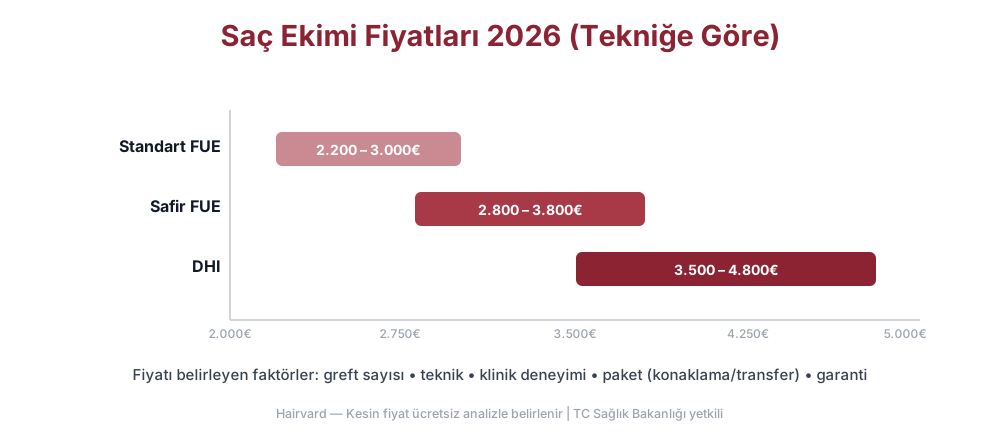
A written guarantee should not add a hidden premium. Prices depend on graft count and technique rather than the guarantee itself. Our cost guide for Turkey explains the real factors; at Hairvard, procedures fall within a EUR 2,200–4,800 range.
What should I do if I need to make a guarantee claim?
Contact the clinic with your signed document and photographs, and request an assessment after the 12–18 month window. Because you kept your paperwork and followed your aftercare, the clinic can evaluate coverage in the treated zone and arrange re-implantation if survival fell short of the agreed rate.
Can I trust guarantees from clinics in Turkey?
Yes, when the clinic is properly licensed and the guarantee is written and signed. Turkey has many highly qualified clinics; the key is verifying credentials and documentation, exactly as you would anywhere. Our complete Turkey guide walks through how to check.
This article was medically reviewed and confirmed by specialist Ibrahim Yilmaz at Hairvard, Atasehir, Istanbul. Every patient's situation is different, and the best way to understand what guarantee terms apply to you is a personal assessment. We invite you to request a free, no-obligation hair analysis with our team — contact Hairvard at +90 530 378 74 87 to discuss your candidacy and receive honest, written guidance tailored to your case.