

A hair transplant is a permanent, once-in-a-lifetime decision, which is exactly why rushing the choice of clinic is one of the most expensive mistakes a patient can make. A search for "best hair transplant clinic" returns hundreds of results, many promising to be the cheapest, the most advanced, or the most "guaranteed." Almost none of those claims are verifiable from a website alone. The clinic that actually deserves your trust is defined by things that are far less flashy: a genuine medical license, a named surgeon with a real track record, visible hygiene standards, and honest, pressure-free communication. This guide walks through exactly what to look for, which questions protect you, and which warning signs should make you pause, so you can evaluate any clinic — anywhere in the world — with confidence.
Key Takeaways
- A medical license from the relevant health authority is non-negotiable. In Turkey, that means a hospital or clinic authorized by the Ministry of Health, not a beauty salon or aesthetic center operating outside medical regulation.
- Who actually performs the procedure is the single most important question. If a clinic cannot give you a clear, written answer about the surgeon's role, treat that as a warning sign.
- An unusually low price is not a bargain. Offers far below the market average usually mean an inexperienced team, an overcrowded schedule, or hidden costs added later.
- "Guaranteed" miracle results are not medically honest. No ethical clinic can promise a specific number of hairs or a 100% graft survival rate; only the process and follow-up can honestly be guaranteed.
- Pressure and urgency tactics are a red flag, not a sign of a good deal. Serious medical decisions deserve time to think, not a countdown.
- The right questions protect you more than any review. Ask about licensing, who performs the surgery, sterilization protocols, complication management, and aftercare — a trustworthy clinic answers openly.
Why Clinic Choice Is So Critical
Despite how it is often marketed, a hair transplant is not a simple cosmetic touch-up — it is a surgical procedure performed under local anesthesia, involving thousands of individual grafts extracted from the scalp, channels opened in the recipient area, and each graft placed by hand or with assisted tools. Hygiene, precise planning, and hands-on experience directly determine both your health and your aesthetic outcome. The wrong clinic can lead to infection, an unnatural hairline, poor graft survival, permanent damage to the donor area, and results that are extremely difficult to correct.
There is also a resource dimension that many patients overlook: once grafts are removed from the donor area, that area does not regenerate them. Your donor supply is finite and valuable. An inexperienced team that mishandles this resource does not just risk a disappointing first result — it can also use up the reserve you might need for a future corrective procedure. This is one of the reasons getting the first surgery right, with the right team, is far safer, more economical, and more comfortable than trying to fix it afterward.
The encouraging part is that identifying a trustworthy clinic is more achievable than it seems once you know what to look for. Turkey has become a global leader in this field, for reasons explained in our guide to why so many patients choose Turkey for a hair transplant — but the same country that hosts excellent clinics also hosts genuinely risky operations. The difference lies entirely in how carefully you choose.
What to Look for in a Good Clinic
Evaluating a clinic reliably means looking at several complementary factors together — no single item on its own tells the whole story. The table below summarizes the core criteria and why each one matters.
| Criterion | What It Means | Why It Matters |
|---|---|---|
| Ministry of Health authorization | The facility holds a hospital or clinic license with medical oversight | Legal accountability and your right to file a complaint if something goes wrong |
| Surgeon experience | Years of hands-on practice and a substantial case history | Directly shapes planning quality and technical execution |
| The doctor's active role | The surgeon is personally involved in the critical stages | Determines consistency and safety of the outcome |
| Hygiene and sterilization | Sterile operating conditions, single-use instruments | Minimizes infection risk |
| Transparent, itemized pricing | A written, all-inclusive quote with no hidden extras | Prevents unpleasant surprises after you commit |
| Honest consultation | Expectations set according to your actual donor capacity | Prevents disappointment and signals genuine integrity |
| Written aftercare plan | A documented follow-up and check-in schedule | Evidence the clinic takes long-term responsibility |
Licensing and Legal Standing
This is the first, non-negotiable criterion. In Turkey, a hair transplant may only legally be performed in a hospital or clinic licensed by the Ministry of Health, under the responsibility of a physician. Procedures carried out under a beauty-salon or "aesthetic center" registration fall outside proper medical regulation and carry serious health risks, regardless of how professional the marketing looks. Always ask which authority licenses the facility, who the responsible physician is, and whether that information is shared transparently and can be verified. At Hairvard, all procedures at our Atasehir, Istanbul center are carried out under Turkish Ministry of Health regulation, under physician responsibility.
Surgeon Experience and Who Actually Performs the Procedure
Experience is one of the biggest determinants of outcome, but it is important to separate two different questions: how experienced is the doctor, and who is actually performing the operation on the day? In some operations, the physician appears only during the initial consultation, while the technical work is carried out by technicians whose training is never disclosed. In a well-run clinic, the physician takes personal responsibility for the critical stages — hairline design, donor planning, anesthesia, and channel opening.
At Hairvard, procedures are planned and led by hair transplant specialist Ibrahim Yilmaz. Knowing exactly where the surgeon stands in the process is a basic patient right, and you should never feel uncomfortable asking for a direct, written answer.
Hygiene, Sterilization and Surgical Facility Standards
A hair transplant requires a sterile environment. Single-use instruments, properly sterilized equipment, and a procedure area that meets surgical facility standards all reduce the risk of infection. If you can visit a clinic in person, pay attention to the cleanliness and order of the operating space. If you are assessing remotely, ask direct questions about sterilization protocols and the materials used — a confident clinic will answer without hesitation.
Transparent, All-Inclusive Pricing
A trustworthy clinic gives you a written, all-inclusive quote. Whether accommodation, medication, an aftercare kit, and follow-up visits are included — or billed separately — should be clear from the very first conversation. Hair transplant prices in Turkey typically range from EUR 2,200 to 4,800, and that range shifts depending on the number of grafts, the technique used, and the scope of services the clinic provides. The image below summarizes the main factors that influence price.
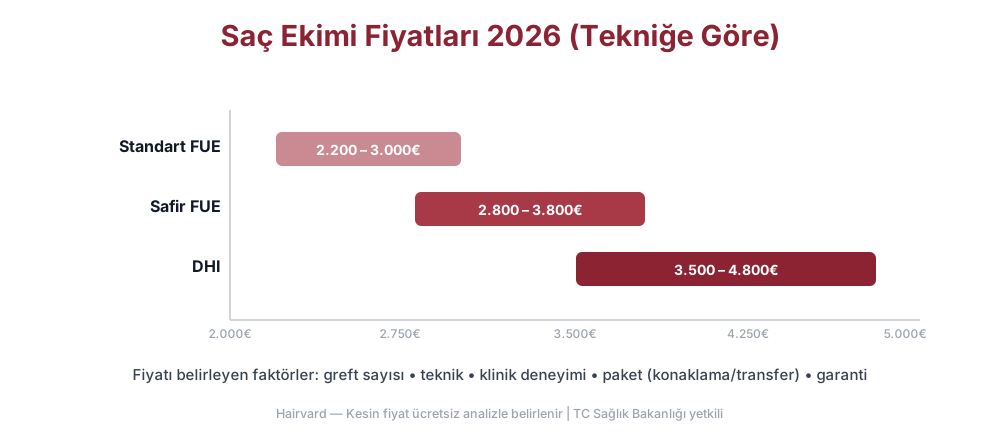
Understanding exactly what a price includes matters more than the number itself. A price that looks unusually low is almost always a sign of missing services or costs that surface later — a point covered in more depth in the red flags section below.
Red Flags to Avoid
Recognizing a risky setup early is just as important as recognizing a good clinic. If one or more of the warning signs below appear, it is worth reconsidering your decision. No single flag is automatically disqualifying, but together they form a strong signal.
| Red Flag | Why It's Risky | What to Do |
|---|---|---|
| Price far below market average | Often means an inexperienced team, overcrowded schedule, or hidden costs | Ask for a written breakdown of exactly what is included |
| "Guaranteed miracle result" promises | Outcomes that cannot be medically promised | Question any claim of 100% graft survival or an exact hair count |
| Pressure and urgency tactics | "Sign today for a discount" prioritizes sales over your health | Walk away from anyone who won't give you time to think |
| Unclear about who performs the procedure | The doctor may not be meaningfully involved | Don't proceed without a clear, written answer |
| Poor or slow communication | Dismissive answers before surgery predict worse support after | Treat pre-op responsiveness as a preview of aftercare |
| Exaggerated before/after claims | Sets unrealistic expectations | Remember results vary by individual biology and donor supply |
| No written contract | Leaves responsibility undocumented | Never proceed without one |
Why Extremely Low Prices Are Dangerous
Everyone wants a fair price, and that is entirely reasonable. But once a hair transplant price drops below a certain threshold, it stops being a "deal" and becomes a warning. Very low prices usually reflect one or more of the following: overcrowded schedules with many patients treated the same day, inexperienced staff, lower-quality materials, or costs like accommodation, medication, and follow-up that are excluded from the headline price and requested later. Rather than asking "how cheap is it," ask "what exactly is included, and who is performing the procedure." We cover this alongside the broader causes of poor outcomes in our guide to whether a hair transplant can fail.
The "Guaranteed Result" Promise
A hair transplant is a medical procedure, and like any medical procedure, outcomes vary from person to person. Graft survival depends on skin type, donor quality, adherence to aftercare, and individual healing. For this reason, absolute claims — "100% of grafts will take" or "we guarantee an exact number of hairs" — are not medically realistic. A serious clinic commits to the process, the plan, and the follow-up, and offers an honest, realistic range for outcomes rather than a fixed promise. Our detailed explainer on what a hair transplant guarantee actually covers breaks down what can and cannot honestly be promised. Whenever you hear the word "guarantee," ask exactly what is being guaranteed, in writing.
Pressure, Urgency and Sales-First Behavior
Health decisions should never be rushed. An approach that pushes you toward a fast signature with phrases like "special discount if you decide today" or "spots are filling up" signals a structure that prioritizes sales over care. A quality clinic gives you time to think, answers your questions patiently, and respects your own pace of decision-making. If you feel a sense of manufactured urgency, that is your cue to step back.
Communication Quality and Transparency
How a clinic treats you before surgery is the clearest available preview of how it will treat you afterward. Are your questions answered clearly, patiently, and transparently — or are they dodged, delayed, or left vague? It is not realistic to expect a clinic that is inattentive before your procedure to be attentive and supportive if a complication arises afterward. Communication is one of the most concrete tests of reliability you have available before you ever set foot in an operating room.
Questions to Ask Before You Decide
Asking the right questions is the single most protective thing you can do. A quality clinic never bristles at these questions — it answers them openly.
| Question to Ask | What a Good Answer Looks Like | Warning Sign |
|---|---|---|
| Who will actually perform the procedure? | The doctor's role is explained clearly and specifically | Vague answers like "our team handles it" |
| What is the clinic's licensing status? | Ministry of Health authorization is stated openly | The topic is deflected or avoided |
| What exactly is included in the price? | A written, itemized breakdown | A vague verbal answer only |
| How many grafts are being planned, and why? | A realistic number based on a donor assessment | An inflated, unrealistic promise |
| How is sterilization handled? | Protocols are explained clearly | The question is brushed aside |
| What happens if there is a complication? | A clear management plan is shared | "That won't happen to you" |
| What does follow-up look like after surgery? | A concrete schedule and communication plan | No commitment or vague timeline |
The goal of asking these questions is not to interrogate the clinic — it is to protect yourself and make an informed decision. How a clinic responds to these questions often tells you as much as the answers themselves. A team that responds with patience and transparency is one you can reasonably trust. After asking these questions verbally, don't hesitate to request the key answers in writing — a serious clinic will consider that a completely normal request.
Evaluating a Clinic Remotely
Patients traveling from other cities or other countries do not always have the option to visit a clinic in person before deciding. If that is your situation, a few points deserve extra attention. First, request a video consultation — it matters that the consultation is conducted by real medical staff, not handled entirely through text messages. Check whether your donor area and hair loss pattern are assessed from photographs and whether you are given a realistic plan based on that assessment, rather than a generic package.
Logistics also need to be settled up front: accommodation, transport, interpretation support, and post-procedure follow-up should all be clarified before you commit. A good clinic stays in touch after you return home and continues monitoring your recovery remotely. The way communication is handled before surgery is the strongest available signal of how it will continue afterward. Take your time, and if it would help, get opinions from more than one clinic before comparing them side by side.
Final Checklist Before You Decide
Once you have weighed all these factors, a short mental checklist can make the final decision easier. Has the clinic's Ministry of Health authorization been confirmed? Is it clear who will perform the procedure? Is the price written and all-inclusive? Were you given a realistic expectation, rather than a promise of a miracle? Did you feel pressured, or were you given time to think it through? Were your questions answered transparently? Is there a written contract and a documented follow-up plan?
If you can answer "yes" to all of these with genuine confidence, you are on solid ground. If you hesitate on any one of them, resolve that point before moving forward. The right clinic is the one that is not bothered by your questions, gives you time, and speaks to you honestly.
Frequently Asked Questions
What is the single most important factor in choosing a hair transplant clinic?
There is no single factor in isolation — several criteria matter together. But the non-negotiable starting point is Ministry of Health authorization. Once that is confirmed, surgeon experience, who actually performs the procedure, and hygiene standards complete a reliable picture.
Is it risky to choose a cheap hair transplant clinic?
Prices far below the market average are usually a warning sign rather than a genuine bargain. They can point to an inexperienced team, overcrowded schedules, or hidden costs. Instead of asking how cheap something is, ask what exactly is included and who performs the procedure.
Can a hair transplant clinic guarantee results?
No. Absolute promises like "100% of grafts will survive" or "you will get an exact number of hairs" are not medically realistic, since outcomes vary by individual. A trustworthy clinic guarantees the process and the follow-up, and gives you an honest, realistic range for results rather than a fixed number.
How do I know if the doctor or a technician is performing my surgery?
Ask directly and request a written answer. Find out specifically which stages the surgeon is personally involved in. Vague responses like "our team takes care of it" are a warning sign; a quality clinic explains the doctor's role transparently.
What should I do if I can't visit a clinic in person?
Request a video consultation with actual medical staff, and make sure your donor area and hair loss pattern are assessed from photographs before you receive a plan. Make sure accommodation, transport, interpretation, and follow-up are all clarified in advance.
How should I respond to a clinic that pressures me to decide quickly?
Step back. Phrases like "special discount if you decide today" or "spots are filling fast" indicate a sales-first approach rather than a health-first one. Medical decisions deserve time, and a quality clinic will never rush you.
Why does a written contract matter so much?
A written contract documents the clinic's responsibilities. When the scope of the procedure, what's included in the price, and the follow-up plan are all in writing, it prevents disputes later. Proceeding without a contract puts you at unnecessary risk.
Why do hair transplant prices vary so much between clinics?
Prices depend on the number of grafts, the technique used, the surgeon's experience, and the scope of included services. In Turkey, the typical range is EUR 2,200 to 4,800. Understanding what a price actually includes matters more than the number by itself.
How many clinics should I consult before deciding?
There's no fixed number, but getting opinions from more than one clinic before deciding is genuinely useful. Comparing the plans, pricing scope, and communication style of different clinics helps you make a more informed choice.
What should I do if a clinic offers an unrealistic plan during consultation?
Your donor supply is limited, and any plan that promises far more than that supply can reasonably support is not realistic. Expect a plan grounded in an actual donor assessment. Be cautious of inflated graft numbers or promises that sound too good to be true.
This article was medically reviewed and confirmed by Ibrahim Yilmaz, hair transplant specialist at Hairvard, Atasehir, Istanbul, licensed by the Turkish Ministry of Health. It is intended for general education and does not replace a personal medical consultation. If you are evaluating clinics and would like an honest, no-obligation assessment of your own situation, Hairvard's specialist team is available for a free hair analysis — with no pressure and complete transparency about what any plan would involve.