

Choosing where to have a hair transplant is rarely just a medical decision — it is also a financial one, and the numbers vary enormously depending on which country you look at. A quote of GBP 4,000 in London and one of EUR 3,200 in Istanbul cannot always be compared at face value, because they often price completely different things. This article breaks down what a hair transplant actually costs in Turkey, the UK, the US and Germany, why the gap is so large, and what genuinely matters when weighing a lower price abroad against a local clinic closer to home. The goal here is not to tell you that one country is automatically "better" — it is to give you the honest context to compare quotes properly and ask the right questions, wherever you decide to have your procedure.
Key Takeaways
- Turkey's typical all-inclusive price for a full FUE or DHI hair transplant is roughly EUR 2,200-4,800, usually covering the surgery, accommodation, transfers and a coordinator or translator.
- UK clinics often quote GBP 4,000-15,000 or more, frequently priced per graft (around GBP 2-5 per graft), with accommodation and travel typically not included since it is usually a local, day-procedure service.
- US prices are among the highest in the world, commonly USD 10,000-30,000+, also often billed per graft (roughly USD 4-10 per graft).
- Germany typically falls in the EUR 6,000-15,000+ range, again often priced per graft or per session rather than as a single package.
- The price gap is driven mainly by differences in cost of living and clinical labor costs between countries — not by one country having inherently better or worse medicine than another.
- High patient volume in Turkey can mean either an efficient, highly experienced surgical team or, at some clinics, an overcrowded and under-supervised operation — volume alone does not tell you which one you are dealing with.
- A like-for-like comparison requires checking what is actually included in the quoted price: surgery only, or surgery plus accommodation, transport, coordinator support and aftercare.
- Every country in this comparison has its own medical licensing and regulatory system (Ministry of Health in Turkey, CQC/GMC in the UK, state medical boards in the US, equivalent bodies in Germany) — verifying proper licensing matters everywhere, not just when traveling abroad.
Why Hair Transplant Prices Vary So Much by Country
At first glance, the price differences between Turkey, the UK, the US and Germany can look almost irrational — how can the "same" procedure cost four or five times more in one country than another? In reality, several genuine, explainable factors are at work, and understanding them helps you compare quotes honestly rather than assuming either that the cheapest option is automatically the smartest, or that the most expensive option is automatically the safest.
Cost of Living and Clinical Labor Costs
The single biggest driver of the price gap is straightforward economics: the cost of running a clinic — staff salaries, facility overhead, rent, equipment, insurance, and general cost of living — is substantially lower in Turkey than in the UK, US or Germany. Surgeons, nurses and technicians in Western Europe and North America generally command higher wages, and clinics in those markets carry higher operating costs across the board. This is not a Turkey-specific phenomenon; it is the same reason many other medical and dental procedures are also less expensive in Turkey, and why medical travel in general tends to flow from higher-cost countries to lower-cost ones. It reflects macroeconomic reality more than any difference in the quality of the medicine itself.
Volume: A Double-Edged Sword
Turkey performs hair transplants at very high volume — arguably higher than any other country in the world, driven partly by medical tourism and partly by strong domestic demand. Volume by itself is not automatically good or bad, and it is important not to oversimplify this point in either direction.
On one hand, high case volume can allow surgical teams to build deep, repetition-based expertise, refine techniques, and run efficient, well-organized clinics with dedicated coordinators, translators and aftercare systems built specifically around international patients.
On the other hand, high volume at some clinics — and this is not unique to Turkey — can also translate into overbooked schedules, technicians handling a disproportionate share of the graft extraction and placement, and less individualized attention than a patient might expect. The honest takeaway is that volume alone tells you nothing definitive about quality. Two clinics performing the same number of monthly procedures could be run in completely different ways, one meticulously supervised and one not. This is precisely why clinic-selection criteria — who actually performs the surgery, what licensing is in place, and what the hygiene and staffing standards look like — matter just as much in Turkey as they do in London, Los Angeles or Berlin. For a deeper look at how to vet a clinic properly, see our guide on how to choose a hair transplant clinic.
What's Actually Included in the Price
This is arguably the most misunderstood factor in cross-border price comparisons. Many Turkish clinics, including Hairvard, quote a single all-inclusive price that bundles the surgical procedure with hotel accommodation, airport transfers, a dedicated patient coordinator or translator, and post-operative aftercare check-ins. A patient comparing a EUR 3,000 all-inclusive Turkish package against a GBP 6,000 UK quote may not realize that the UK figure typically covers the surgery alone, with flights, hotel stays (if traveling from elsewhere in the UK), and follow-up visits billed separately or requiring separate trips. Once you add up equivalent extras, the real gap between the two often narrows — though it rarely disappears completely. A fair comparison requires asking every clinic, in every country, exactly what is and is not included before drawing conclusions from the headline number.
Regulatory Systems Differ, But All Are Legitimate
Every country covered in this article has its own medical regulatory framework governing who can perform hair transplants and under what conditions:
- Turkey: clinics and the physicians performing surgical procedures are regulated by the Turkish Ministry of Health.
- UK: healthcare facilities are regulated by the Care Quality Commission (CQC), while individual doctors are registered with the General Medical Council (GMC).
- US: physician licensing is handled at the state level through individual state medical boards.
- Germany: medical practice is regulated through the Bundesärztekammer (Federal Chamber of Physicians) and state-level medical associations (Landesärztekammern).
None of these systems is inherently superior to the others — they are simply different national frameworks for the same underlying goal of ensuring qualified practitioners perform medical procedures safely. The honest and practical point for a patient is not "which country's regulator is best," but "have I verified that this specific clinic and this specific surgeon are properly licensed under whichever system applies." That verification step matters identically whether you are booking a clinic in Istanbul, Manchester, Miami or Munich.
Turkey: All-Inclusive Pricing Explained
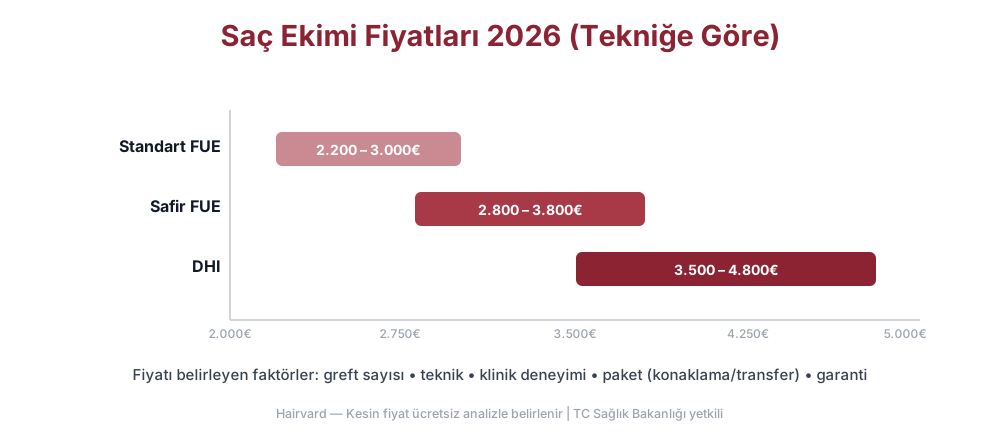
Hairvard and most established Turkish clinics price a full FUE or DHI hair transplant — typically covering several thousand grafts, enough for most moderate-to-extensive cases of male or female pattern hair loss — at roughly EUR 2,200 to EUR 4,800 for the entire package. This is not a per-graft price; it is usually a flat fee for the procedure regardless of the exact graft count within the planned range, which makes budgeting considerably more predictable for patients.
What this price typically includes:
- The surgical procedure itself (FUE or DHI, sometimes both combined depending on the technique chosen)
- Pre-operative consultation and hairline/graft planning
- Hotel accommodation for the duration of the visit (commonly 2-4 nights)
- Airport-to-clinic and clinic-to-hotel transfers
- A dedicated patient coordinator and/or translator throughout the visit
- Post-operative care instructions, initial wash guidance, and follow-up communication under medical supervision
Because so many Turkish clinics compete on a similar all-inclusive model, this pricing structure has become something of an industry standard for medical travel to Istanbul specifically. It is genuinely convenient for international patients who would otherwise need to independently arrange accommodation, local transport and translation on top of the medical procedure itself — but it also means the "sticker price" already has built-in costs that a UK or US quote may not.
The UK: Local Convenience, Per-Graft Pricing
In the UK, hair transplant pricing is most commonly structured on a per-graft basis, typically in the range of roughly GBP 2 to GBP 5 per graft, though this varies by clinic, technique and geographic location (London clinics tend to sit at the higher end). For a procedure requiring 3,000-4,000 grafts, this per-graft structure can produce a total bill anywhere from GBP 4,000 up to GBP 15,000 or considerably more for larger or more complex cases.
A few honest distinctions are worth noting:
- UK clinics are generally serving a domestic or nearby-international patient base for whom this is a day procedure or a short local stay — accommodation is typically not part of the clinic's offering because most patients simply go home the same day or the next.
- Follow-up appointments are usually easier to arrange in person, since the patient is either already local or within a short domestic trip of the clinic.
- Per-graft pricing can make costs highly transparent in one sense (you know the exact rate) but harder to predict in another, since the final graft count is often only confirmed on the day of the procedure.
Illustrative UK Cost Range by Graft Count
| Graft Count | Approx. Cost at GBP 2/graft | Approx. Cost at GBP 5/graft |
|---|---|---|
| 1,500 grafts | GBP 3,000 | GBP 7,500 |
| 2,500 grafts | GBP 5,000 | GBP 12,500 |
| 3,500 grafts | GBP 7,000 | GBP 17,500 |
| 4,500 grafts | GBP 9,000 | GBP 22,500 |
Figures are illustrative approximations based on commonly quoted UK per-graft rates and will vary by clinic.
The US: Among the Highest-Cost Markets Globally
The United States sits at the top end of the global price range for hair transplants, with total costs commonly falling between USD 10,000 and USD 30,000 or more for a full procedure. Like the UK, US clinics frequently quote per graft, roughly USD 4 to USD 10 per graft, with the final price depending heavily on the surgeon's reputation, the clinic's location (major metropolitan areas tend to command a premium), and the technique used.
Higher US pricing reflects several of the same underlying factors discussed earlier: significantly higher clinical labor costs, higher malpractice insurance and facility overhead, and a healthcare market generally priced at a premium compared to most of the world. As in the UK, follow-up visits are typically easy to arrange locally since most patients are being treated relatively close to home, which is a genuine convenience factor worth weighing against the higher sticker price.
Germany: A Similar Pattern to the UK and US
Germany's hair transplant market typically prices procedures in the EUR 6,000 to EUR 15,000+ range, again most often structured per graft or per session rather than as a single flat package. German clinics benefit from a well-established, highly regulated healthcare system, and pricing reflects Western European labor and operating costs similar to those seen in the UK. As with the UK and US, accommodation and travel are generally the patient's own responsibility and are billed separately, if needed at all, since many German patients are treated locally.
Side-by-Side Cost Comparison
The table below summarizes the typical pricing patterns across all four countries. These are general market ranges intended to illustrate the overall landscape, not quotes for any specific clinic.
| Country | Typical Total Cost Range | Pricing Structure | Accommodation Included? | Follow-Up Convenience |
|---|---|---|---|---|
| Turkey | EUR 2,200 - 4,800 | All-inclusive flat package | Usually yes | Requires return travel for in-person follow-up |
| UK | GBP 4,000 - 15,000+ | Per graft (~GBP 2-5/graft) | Usually no | Easy if treated locally |
| US | USD 10,000 - 30,000+ | Per graft (~USD 4-10/graft) | Usually no | Easy if treated locally |
| Germany | EUR 6,000 - 15,000+ | Per graft or per session | Usually no | Easy if treated locally |
What Drives the Price Gap: A Balanced Breakdown
| Factor | How It Affects Price | Honest Takeaway |
|---|---|---|
| Cost of living / labor costs | Lower operating costs in Turkey reduce overall pricing | Reflects economics, not necessarily medical quality |
| Patient volume | Turkey performs very high volumes of procedures | Can mean either efficient expert teams or under-supervised operations — volume alone doesn't tell you which |
| Package inclusions | Turkish prices often bundle hotel, transfers, coordinator; UK/US/German quotes often price surgery alone | Naive price comparisons are misleading unless inclusions are matched |
| Regulatory framework | Each country has its own licensing body (Ministry of Health, CQC/GMC, state boards, German medical chambers) | Verifying proper licensing matters everywhere, not just abroad |
| Travel distance for follow-up | International patients must travel back for in-person revision or checkup | A genuine trade-off, not a reason to avoid international care |
Frequently Asked Questions
Why are hair transplants so much cheaper in Turkey?
Turkey's lower prices mainly reflect a lower cost of living and very high patient volume, which lets clinics operate efficiently and offer competitive rates. Many clinics also bundle the procedure into all-inclusive packages that combine the surgery, accommodation, and airport transfers, so the headline figure often covers more than the operation alone. As a result, treatments there commonly fall in the 2,200-4,800€ range rather than the higher prices seen in many other countries.
Is it safe to get a hair transplant in Turkey given the low cost?
A lower price does not automatically mean lower quality, but safety depends heavily on choosing the right clinic rather than the cheapest one. Before booking, verify that the facility is properly licensed and that the procedure is carried out by qualified medical staff, and confirm that any medications are prescribed and used under physician supervision. Ask detailed questions about who performs the surgery, the hygiene standards, and the aftercare provided, since these factors matter far more than the country or the sticker price.
Why is a hair transplant so much cheaper in Turkey than in the UK or US?
The price difference mainly reflects lower cost of living and clinical labor costs in Turkey compared to the UK, US and Germany, combined with the fact that Turkish clinics often bundle accommodation, transfers and coordinator support into one all-inclusive price rather than billing them separately. It is a market and economic difference, not necessarily an indicator of lower medical quality.
Is a cheaper hair transplant in Turkey lower quality?
Not inherently. Price differences are largely explained by cost-of-living and packaging factors rather than clinical quality. That said, quality varies between individual clinics in every country, so the price alone should never be used as a proxy for how good a specific clinic is. Checking licensing, surgeon qualifications and hygiene standards matters regardless of the country.
What is included in Hairvard's all-inclusive price of EUR 2,200-4,800?
This range typically covers the full FUE or DHI surgical procedure, pre-operative planning, hotel accommodation, airport and clinic transfers, a dedicated patient coordinator or translator, and post-operative aftercare guidance under medical supervision. Always confirm the specific inclusions directly with the clinic before booking.
Why do UK and US clinics price per graft instead of as a flat package?
Per-graft pricing is common in markets where hair transplants are typically treated as local, day-procedure services rather than medical-travel packages. Since patients are usually not requiring accommodation or transfer services, clinics price the surgical component alone, scaled to the number of grafts required.
How many grafts does a typical hair transplant require?
This varies enormously by the extent of hair loss, the size of the area being treated, and the density desired. Mild-to-moderate cases might require 1,500-2,500 grafts, while more extensive hair loss can require 4,000 grafts or more. A qualified surgeon should assess this individually rather than quoting a number before an in-person or detailed remote consultation.
Does Turkey have proper medical licensing for hair transplant clinics?
Yes. Hair transplant clinics and the physicians performing procedures in Turkey are regulated under the Turkish Ministry of Health. As with any country, patients should verify that a specific clinic and surgeon hold valid, current licensing rather than assuming this is universal across every operator in the market.
What happens if I need a follow-up appointment after traveling to Turkey?
Most follow-up care can be handled remotely through photos, video calls and coordinator support under medical supervision, and this covers the needs of the great majority of patients. However, if an in-person revision or check-up is genuinely needed, you would need to arrange additional travel back to the clinic, which is a real logistical and cost consideration worth weighing before you book.
Is it safer to get a hair transplant close to home?
Not necessarily "safer" in a blanket sense — safety depends on the specific clinic's licensing, hygiene standards, and who performs the surgery, which varies within every country. What is genuinely easier when treated locally is arranging in-person follow-up or revision work without additional travel, which is a real convenience rather than a safety guarantee.
Why do prices vary so much even within the same country?
Within any single country, prices vary based on clinic location (major cities generally cost more), the surgeon's experience and reputation, the technique used (FUE versus DHI, for example), and how many grafts a specific case requires. This is true in Turkey, the UK, the US and Germany alike.
This article was medically reviewed by Ibrahim Yilmaz, hair transplant specialist. It is intended for general educational purposes and does not replace individual medical advice. If you would like a personalized assessment of your case and a transparent, all-inclusive price quote, Hairvard offers a free, no-obligation consultation to discuss your options honestly and help you decide what is right for you.