

Beard, moustache and eyebrow transplants restore facial hair by relocating your own permanent hair, usually from the back of the scalp, into thin or bare areas of the face. At Hairvard in Istanbul, these procedures are most often performed with the DHI (Direct Hair Implantation) technique, which allows a specialist to control the exact angle, depth and direction of each graft so that new hairs grow in a natural pattern. This article explains why patients choose facial hair transplants, how the process works for each area, typical graft counts, and what a realistic results timeline looks like.
Key Takeaways
- Facial hair transplants move permanent hair (typically from the nape/scalp donor area) into the beard, moustache, sideburns or eyebrows to fill gaps, scars or naturally sparse zones.
- DHI is the preferred technique for the face because it gives precise control over the angle and direction of every implanted hair, which matters enormously on the highly visible facial skin.
- Graft counts vary by area: a full beard commonly needs 1,500–3,000 grafts, a moustache 300–700, and each eyebrow around 150–350 grafts.
- Eyebrows are the most delicate area because hairs must be placed at a very flat angle and in a specific fan-shaped pattern to look natural.
- Recovery is quick: most crusts fall away within 7–10 days, transplanted hairs shed at 2–4 weeks, and final results typically appear at 9–12 months.
- Hairvard is licensed by the Turkish Ministry of Health, and every case is planned individually — results always vary by individual.
Why People Choose a Facial Hair Transplant
Facial hair carries strong social and personal meaning, and patchy growth can affect confidence at any age. A transplant offers a permanent solution when creams, minoxidil or waiting have not produced the density a person wants.
Common reasons patients come to Hairvard for beard, moustache or eyebrow work include:
- Genetic sparseness — some men simply never grow a full beard or thick eyebrows.
- Scarring — from acne, surgery, burns, piercings or accidents that leave bald patches.
- Over-plucking — especially eyebrows thinned by years of grooming, which sometimes stop regrowing.
- Medical hair loss — conditions such as alopecia areata (once stable) or the effects of past treatments.
- Gender-affirming goals — building a fuller, more masculine beard line.
- Shaping and design — extending a patchy beard, connecting a moustache to the beard, or restoring lost sideburns.
Because the transplanted hair is taken from an area that is genetically resistant to loss, it is considered permanent once it settles and grows.
The Donor Area: Where the Hair Comes From
For almost all facial hair transplants, the donor area is the nape and back of the scalp. This region provides hair that is a close match in thickness for beard and eyebrow work, and it is hidden by surrounding hair after healing.
| Recipient area | Usual donor source | Why this donor is chosen |
|---|---|---|
| Beard & moustache | Nape / back of scalp | Similar caliber to facial hair; large supply |
| Eyebrows | Nape or fine scalp hair above the ear | Finer, softer hairs match brow texture |
| Sideburns | Back of scalp | Good density and directional match |
The specialist assesses your donor supply during the consultation. If you would like to understand the fundamentals of how grafts are harvested and relocated, our overview of what a hair transplant is explains the core principles that apply to every area of the body.
Beard Transplant: Method, Design and Process
Why the beard is transplanted
A beard transplant fills patchy cheeks, thin jawlines, gaps in the moustache-to-chin connection, and scars. It can also create a beard where there was almost none, giving a fuller, more even appearance.
Which technique: mostly DHI
Beard transplants at Hairvard are usually performed with DHI (Direct Hair Implantation). With DHI, each graft is loaded into a fine implanter pen and placed directly into the skin without pre-cut channels. This gives the surgeon direct control over three things that define a natural beard:
- Angle — beard hairs exit the skin at a sharp, low angle.
- Direction — hairs flow downward and outward in a consistent pattern.
- Density — grafts can be placed closely for a full look.
To understand how this method differs from the classic channel-opening approach, see our comparison of FUE vs DHI hair transplant.
Graft counts for the beard
The number of grafts depends on how much area needs coverage and your desired density.
| Beard zone | Typical graft range |
|---|---|
| Moustache | 300 – 700 |
| Chin / goatee | 400 – 900 |
| Cheeks (each side) | 300 – 800 |
| Sideburns (each) | 200 – 400 |
| Full beard (combined) | 1,500 – 3,000 |
Angle and direction precision
The single most important factor in a natural beard is angle. Facial hair grows almost flat against the skin, so grafts are implanted at a very acute angle. On the cheeks the hairs point down and slightly toward the mouth; along the jaw they follow the jawline; under the chin they turn inward. A skilled specialist maps these directions before implantation so the finished beard looks like it grew there naturally.
Beard process step by step
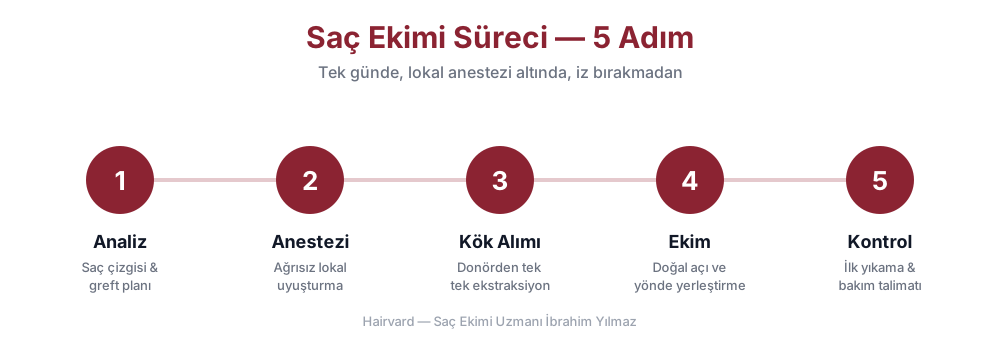
- Consultation and design — the beard line and density are drawn and agreed with you.
- Local anesthesia — the donor and recipient areas are numbed.
- Graft harvesting — individual follicular units are extracted from the nape/scalp.
- DHI implantation — grafts are placed one by one at the planned angle and direction.
- Aftercare briefing — you receive washing and care instructions before leaving.
The procedure typically takes 4–7 hours depending on graft numbers.
Moustache Transplant
A moustache transplant is essentially a focused version of a beard procedure. It targets the area between the nose and upper lip to close gaps, thicken sparse growth, or rebuild a moustache lost to scarring.
Key points for the moustache:
- Graft count is usually 300–700, depending on width and density goals.
- Angle is critical — moustache hairs grow steeply downward over the lip, so precise implantation prevents an unnatural "brush" look.
- Sensation — the upper lip is sensitive, so careful anesthesia and gentle handling matter.
- Eating and drinking need extra care in the first days to protect the new grafts.
Eyebrow Transplant: The Most Delicate Area
Why eyebrows are special
Eyebrows frame the face, and even tiny errors in angle or direction are immediately visible. This makes eyebrow transplantation the most technically demanding facial procedure and the one where an experienced hand matters most.
Why DHI is preferred for eyebrows
DHI is almost always chosen for eyebrows because the implanter pen allows hairs to be placed at an extremely flat angle — often nearly parallel to the skin — which is essential for a soft, natural brow. Each hair must also follow the eyebrow's natural flow.
Eyebrow design and direction
A natural eyebrow is not a single line — it is a fan of hairs pointing in changing directions:
- At the head (inner edge), hairs point upward and outward.
- Across the body, they gradually sweep outward.
- Toward the tail, they angle downward and outward.
Getting this fan pattern right is what separates a natural result from an obvious one.
Eyebrow graft counts
| Eyebrow work | Typical graft range (per brow) |
|---|---|
| Light filling / gaps | 100 – 180 |
| Moderate reshaping | 180 – 280 |
| Full reconstruction | 280 – 400 |
Important note on eyebrow hair
Because eyebrow grafts come from scalp hair, they keep some scalp-hair characteristics — most notably, they continue to grow longer than natural brow hairs. This means eyebrows usually need regular trimming for life. The specialist will explain this during your consultation so expectations are clear.
Comparison: Beard vs Eyebrow vs Scalp Transplant
Understanding how facial procedures differ from a standard scalp transplant helps set realistic expectations.
| Feature | Scalp | Beard / Moustache | Eyebrow |
|---|---|---|---|
| Usual technique | FUE or DHI | Mostly DHI | Almost always DHI |
| Typical grafts | 2,000 – 4,500 | 300 – 3,000 | 150 – 400 (per brow) |
| Hair angle | Moderate | Sharp / low | Very flat / near-parallel |
| Design difficulty | Moderate | High | Highest |
| Ongoing trimming | As normal | Shave as normal | Frequent trimming needed |
| Procedure length | 6 – 8 hrs | 4 – 7 hrs | 2 – 4 hrs |
Recovery and Aftercare
Recovery from facial hair transplants is generally quick and comfortable, but the first two weeks require care to protect the grafts.
First 24–72 hours
- Mild swelling and redness are normal.
- Tiny crusts form around each implanted hair.
- Sleep on your back to avoid rubbing the area.
Days 3–10
- Gentle washing begins as instructed.
- Crusts soften and fall away — do not pick them.
- Most people can return to normal social activity within a few days.
Weeks 2–4
- The transplanted hairs shed — this is expected and temporary ("shock loss").
- The follicles remain safely in place beneath the skin.
For a full week-by-week breakdown that applies to facial and scalp procedures alike, see our hair transplant recovery timeline.
General aftercare rules
- No shaving or trimming the recipient area until cleared (usually ~2 weeks for beard).
- Avoid heavy sweating, gym, sauna and swimming for about 2 weeks.
- Protect the area from direct sun.
- Do not touch, scratch or rub the grafts.
- Follow all washing instructions precisely.
Results Timeline
Facial hair transplants follow the same biological pattern as scalp transplants: an initial shed, a quiet phase, then gradual regrowth.
| Time after procedure | What to expect |
|---|---|
| Days 1–10 | Healing, crusts fall, redness fades |
| Weeks 2–4 | Transplanted hairs shed (normal) |
| Months 2–3 | Dormant phase; little visible growth |
| Months 3–4 | New hairs begin to sprout |
| Months 6–8 | Noticeable density and thickening |
| Months 9–12 | Near-final result; full maturity |
Results vary by individual based on graft survival, donor quality, aftercare and personal healing. Most patients see their final beard or eyebrow shape between 9 and 12 months.
Are the Results Permanent?
Yes — because the transplanted follicles come from a donor area resistant to hair loss, they are considered a permanent addition once they establish and grow. The hairs behave like their donor source: beard grafts grow like beard hair, and eyebrow grafts (from scalp) keep growing and need trimming.
It is honest to note that not every graft survives — a normal proportion is lost during the shedding phase, which is why realistic density planning during the consultation is so important.
Who Is a Good Candidate?
You may be a suitable candidate if you have:
- A stable, adequate donor area on the scalp/nape.
- Realistic expectations about density and design.
- Good general health and no active skin infection in the target area.
- Any underlying condition (e.g. alopecia areata) that is stable and assessed by the specialist.
A personalised assessment is the only way to confirm suitability, graft numbers and expected outcome.
Frequently Asked Questions
Is a beard or eyebrow transplant permanent?
Yes. Because the grafts come from a donor area resistant to hair loss, they are considered permanent once they settle and grow, though a normal proportion of grafts is naturally lost during shedding.
Does a facial hair transplant hurt?
The procedure is performed under local anesthesia, so you should feel little to no pain during it. Mild tenderness or tightness afterward is normal and usually settles within a few days.
Which technique is best for beard and eyebrow transplants?
DHI (Direct Hair Implantation) is the most common choice because the implanter pen gives precise control over the angle and direction of each hair — essential for natural-looking facial hair and especially eyebrows.
Where does the transplanted hair come from?
For most facial procedures, hair is taken from the nape and back of the scalp. For eyebrows, finer scalp hairs are often selected to better match the delicate brow texture.
How many grafts do I need for a full beard?
A full beard commonly requires 1,500–3,000 grafts, but the exact number depends on the area to be covered and your desired density. A consultation determines your precise plan.
How many grafts does an eyebrow transplant need?
Each eyebrow typically needs around 150–400 grafts depending on whether you want light filling, reshaping or full reconstruction.
Will I need to trim my transplanted eyebrows?
Yes. Because eyebrow grafts come from scalp hair, they continue to grow longer than natural brow hairs and require regular trimming for life.
When will I see the final results?
Transplanted hairs shed within 2–4 weeks, regrowth begins around months 3–4, and the near-final result typically appears between 9 and 12 months.
Is there visible scarring after a facial hair transplant?
With the follicular-unit methods used, there is no linear scar. The donor area in the scalp heals with tiny dots that are hidden by surrounding hair.
How long does the procedure take?
An eyebrow transplant usually takes 2–4 hours, while a beard or moustache procedure typically takes 4–7 hours depending on the number of grafts.
Can I shave after a beard transplant?
Not immediately. You should wait until the specialist clears you — usually around two weeks — before trimming or shaving the transplanted area.
What is "shock loss" and is it normal?
Shock loss is the temporary shedding of the transplanted hairs at 2–4 weeks. It is completely normal; the follicles stay in place and produce new, permanent hairs over the following months.
Can a facial hair transplant cover scars?
Yes. Transplants are frequently used to place hair over acne scars, surgical scars, burns and other bald patches in the beard or eyebrow region, provided the tissue is healthy enough to support grafts.
How much does a beard or eyebrow transplant cost at Hairvard?
Costs depend on the number of grafts and the area treated. Hairvard's procedures generally fall within a range of EUR 2,200–4,800; a free hair analysis gives you an exact, personalised quote.
This article was medically reviewed by Ibrahim Yilmaz, Hair Transplant Specialist at Hairvard, a clinic licensed by the Turkish Ministry of Health in Atasehir, Istanbul. It is provided for general information and does not replace a personal medical consultation. Results vary by individual. To find out whether a beard, moustache or eyebrow transplant is right for you, contact us at +90 530 378 74 87 for a free, no-obligation hair analysis.