

Beard density is one of the few areas of facial appearance that grooming alone cannot fix. If your beard grows in patches, thins along the cheeks, or never filled in past your early twenties, no oil, supplement, or styling trick will create hair where the follicles simply are not present. A beard transplant addresses this directly by relocating your own permanent hair into the beard region, following the natural direction and density of facial hair. For men who feel their beard does not match the fullness they want, it is a one-time, permanent procedure that works with your existing biology rather than against it. This guide explains exactly how a beard transplant works, who it suits, the graft counts involved, how the beard line is designed, and what to expect through healing and final results.
At Hairvard in Atasehir, Istanbul, beard transplants are performed under the supervision of specialist Ibrahim Yilmaz, using the same follicular unit techniques applied in scalp restoration. Because facial hair is highly visible and grows at sharp, precise angles, beard work rewards careful planning and an experienced hand more than almost any other transplant. Below, we cover the method, the process, and the realistic results you can expect.
Key Takeaways
- A beard transplant relocates permanent follicles from the back of your scalp (the nape/donor area) into the beard, filling patchy, sparse, or absent facial hair.
- Most beard work uses DHI or FUE techniques, which allow precise control over the angle and direction that facial hair demands.
- Typical graft counts range from around 250–800 grafts for gaps or a defined line up to 2,500+ grafts for a full beard from very little existing hair.
- Results are permanent because donor follicles keep their genetic resistance to thinning, but the final look takes 8–12 months to mature.
- Beard-line design is the single most important factor in a natural outcome; angles, density gradients, and facial proportions all matter.
- At Hairvard, prices sit within the EUR 2,200–4,800 range depending on graft count, with every plan reviewed by specialist Ibrahim Yilmaz.
What Is a Beard Transplant?
A beard transplant is a minimally invasive procedure that moves individual hair follicles from a donor region, usually the back and sides of the scalp, into the beard and moustache area. It is the same core principle as a scalp hair transplant: healthy follicles are extracted one by one and re-implanted where hair is wanted. The difference lies in the artistry. Facial hair grows at flatter, more acute angles than scalp hair, and each region of the beard, jawline, cheeks, moustache, chin, and sideburns, has its own natural growth direction.
Once transplanted, the relocated follicles behave like beard hair. They grow continuously, can be shaved, trimmed, and styled, and respond to the same grooming you would give any facial hair. Because the follicles come from a genetically resistant zone, they remain in place for life.
Beard transplants suit a wide range of men, not only those with no beard at all. The most common motivations include:
- Patchy growth with bald spots on the cheeks or chin that never fill in.
- Sparse or thin coverage that looks fine from a distance but shows skin up close.
- Scarring from acne, injury, surgery, or burns that left hairless gaps.
- A weak or undefined jawline that a fuller beard can visually strengthen.
- Little to no facial hair, often due to genetics or hormonal factors.
Who Is a Good Candidate?
The ideal candidate has a healthy scalp donor area with enough permanent follicles to harvest, realistic expectations, and stable overall health. Because the donor supply on the scalp is finite and shared with any future scalp needs, a proper assessment matters before committing.
| Candidate profile | Typical goal | Suitability |
|---|---|---|
| Patchy beard with defined gaps | Fill cheek/chin bald spots | Excellent |
| Sparse, thin overall beard | Add density and fullness | Very good |
| Little or no facial hair | Build a full beard | Good, needs more grafts |
| Acne or surgical scarring | Cover hairless scar tissue | Good, case-dependent |
| Very limited scalp donor supply | Any large beard goal | Limited, needs review |
Men who are still in their late teens are usually asked to wait, since facial hair can continue developing naturally into the early or mid-twenties. Those with certain skin conditions, bleeding disorders, or unrealistic density expectations may also need a tailored discussion first. A free analysis with the clinic clarifies exactly what your donor area can support.
The Donor Area: Where Beard Grafts Come From
For nearly all beard transplants, the donor follicles come from the nape and lower back of the scalp, just above the neck. This zone is chosen because its hair is fine, grows in single units, and closely resembles the calibre of natural beard hair, giving a soft, believable result rather than coarse, wiry tufts.
In some cases, existing beard hair or hair from under the chin can supplement the donor supply, but the scalp remains the primary source. The extraction leaves no linear scar; instead, tiny dot-like healing points that fade and are hidden by surrounding hair.
| Donor source | Hair characteristics | When used |
|---|---|---|
| Nape / lower scalp | Fine, single grafts, beard-like | Standard for most cases |
| Sides of scalp | Slightly thicker, single/double | Larger density needs |
| Under-chin beard hair | Native beard texture | Supplementary, select cases |
Matching donor texture to the target region is part of what makes a beard look grown rather than placed. This is why the planning stage carries so much weight.
Beard Transplant Techniques: DHI and FUE
Beard transplants almost always use one of two follicular unit methods. Both extract grafts individually, leaving no strip scar, but they differ in how follicles are implanted. Understanding the distinction helps you discuss your plan with confidence, and our detailed FUE vs DHI comparison covers this in depth.
DHI (Direct Hair Implantation) uses a Choi implanter pen that loads each follicle and places it directly into the skin in a single motion. The surgeon controls the exact angle, depth, and direction at the moment of implantation. For beard work, this precision is a major advantage, since facial hair must lie almost flat against the skin at sharp angles. DHI is the most common choice for beards.
FUE (Follicular Unit Extraction) extracts grafts the same way but creates the recipient sites first, then places follicles into them. It is highly effective and may be preferred for larger sessions or specific density patterns.
| Feature | DHI | FUE |
|---|---|---|
| Implantation | Direct via Choi pen | Channels opened first |
| Angle control | Very high | High |
| Best for beards | Most common choice | Large or dense cases |
| Shaving of recipient | Often not required | Sometimes required |
| Healing pace | Fast | Fast |
The right technique depends on your existing beard, the area treated, and the density goal. Ibrahim Yilmaz selects the approach during planning rather than applying a fixed method to every patient.
Graft Counts by Beard Area
One of the most practical questions is how many grafts a beard needs. The answer depends entirely on the area treated and the density you want. Facial hair does not require the same coverage everywhere; a full, dense cheek needs far more grafts than a moustache touch-up.
The table below gives realistic ranges used in planning. Actual numbers are always confirmed after examining your beard and donor supply.
| Beard region | Typical graft range | Notes |
|---|---|---|
| Moustache | 350–600 | Careful angling near the lip |
| Chin (goatee) | 400–700 | Popular standalone area |
| Cheeks (per side) | 300–600 | Density defines fullness |
| Sideburns (per side) | 200–400 | Frames the face |
| Jawline definition | 300–500 | Sharpens the lower face |
| Full beard (from sparse) | 1,500–2,500+ | Combines all regions |
Most single-area cases fall between 250 and 800 grafts, while a complete beard built from very little existing hair can require 2,500 or more. Because grafts are placed one at a time at precise angles, a larger beard session takes longer but follows the same careful, unit-by-unit approach.
Designing a Natural Beard Line
Design is where a beard transplant succeeds or fails. A technically flawless implantation with a poorly planned line will still look artificial, while a well-designed beard blends so naturally that no one can tell it was transplanted. Several principles guide the design.
- Growth direction: Every zone has its own angle. Cheek hair points down and slightly forward, moustache hair grows outward from the centre, and the chin fans downward. These must be replicated exactly.
- Density gradient: Natural beards are not uniformly dense. The design tapers density at the edges so the beard fades into the skin rather than stopping in a hard line.
- Facial proportion: The cheek line and neckline are set to suit your bone structure, face shape, and how you intend to wear the beard, trimmed short or grown out.
- Symmetry with movement: Perfect mirror symmetry looks unnatural. A skilled design allows subtle variation so the beard reads as genuinely grown.
You are shown and asked to approve the planned line before any extraction begins. This collaborative step ensures the result matches your face and your preferences, not a generic template.
The Beard Transplant Process Step by Step
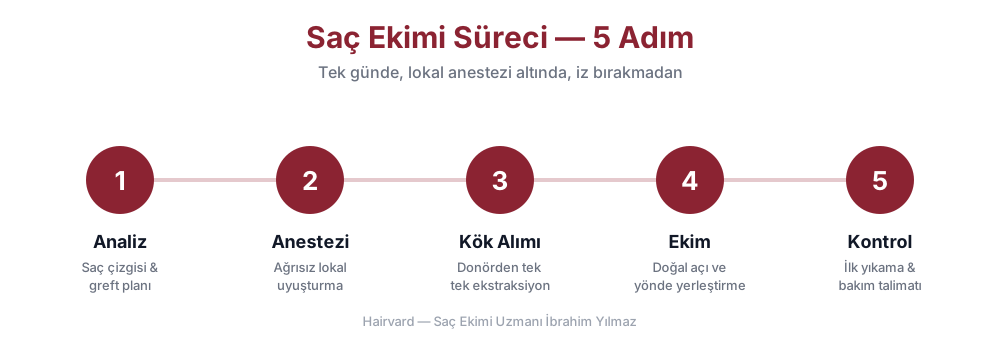
A beard transplant is an outpatient procedure completed in a single day under local anaesthesia. You are awake and comfortable throughout, and you go home the same evening. Here is what the day involves.
- Consultation and design. Your beard and donor area are assessed, graft numbers agreed, and the beard line drawn and approved with you.
- Preparation. The donor zone at the nape is trimmed, and both areas are cleaned. Local anaesthetic is applied so the process is painless.
- Graft extraction. Individual follicles are harvested one by one from the donor area using a micro-punch, then sorted and kept in a preserving solution.
- Recipient preparation or direct implantation. With DHI, follicles are loaded into the Choi pen; with FUE, tiny recipient channels are created at the correct angles first.
- Implantation. Each follicle is placed at the precise angle and direction for its beard zone, building density gradually and naturally.
- Final check and aftercare briefing. The result is reviewed, the area cleaned, and you receive detailed home-care instructions.
The whole procedure typically takes four to eight hours depending on graft count. Most men find it far more comfortable than expected, with the only real sensation being the initial anaesthetic.
| Stage | Approximate duration | What happens |
|---|---|---|
| Consultation and design | 30–60 minutes | Assessment, line drawing, approval |
| Anaesthesia and prep | 30 minutes | Numbing, cleaning, trimming donor |
| Extraction | 1–3 hours | Harvesting individual follicles |
| Implantation | 2–4 hours | Placing grafts at correct angles |
| Briefing | 15–30 minutes | Aftercare instructions |
Healing and Recovery Timeline
Recovery from a beard transplant is quicker and less visible than many expect, though the transplanted hair goes through predictable stages before the final result appears. Understanding this timeline prevents unnecessary worry, particularly during the shedding phase.
In the first few days, tiny crusts form around each implanted follicle, and mild redness or slight swelling is normal. These crusts fall away within about a week. Between weeks two and four, most or all of the transplanted hairs shed, this is completely expected and does not mean the grafts have failed. The follicles remain safely in place beneath the skin and enter a resting phase before regrowing.
| Timeframe | What to expect |
|---|---|
| Days 1–3 | Redness, tiny crusts, mild swelling |
| Days 4–7 | Crusts fall away, gentle washing begins |
| Weeks 2–4 | Transplanted hairs shed (normal) |
| Months 2–4 | New growth begins to appear |
| Months 4–8 | Beard thickens and fills in |
| Months 8–12 | Final density and full result |
Most men return to work within a couple of days, since the donor area is easily covered and the beard region shows only mild redness that settles quickly. Careful aftercare in the first two weeks, gentle washing, avoiding touching or picking, and following the clinic's instructions, protects the grafts during their most delicate phase.
Are the Results Permanent?
Yes. The follicles taken from the nape are genetically programmed to resist the hormonal thinning that affects other hair, and they keep this property after being moved to the beard. Once the transplanted hairs regrow, they are there for life and behave exactly like the facial hair around them, they can be shaved, trimmed, dyed, and grown out.
It is worth setting expectations honestly. A beard transplant does not stop native beard hair from any future changes, and in rare cases a small touch-up session may be added later to increase density or refine a specific area. The transplanted grafts themselves, however, are a permanent addition. This durability is exactly why the design and angle work at the planning stage matter so much: the result you build is the result you keep.
Beard Transplant Cost
Beard transplant pricing depends primarily on the number of grafts required, which in turn reflects how much of the beard is being built or filled. A moustache or small gap needs far fewer grafts than a full beard created from sparse growth, and the cost scales accordingly.
At Hairvard, beard transplants fall within our overall EUR 2,200–4,800 range. The exact figure is confirmed only after your beard and donor area are assessed, so the quote reflects your real needs rather than a generic package.
| Beard goal | Typical graft range | Relative cost |
|---|---|---|
| Small gap or moustache | 250–600 | Lower end |
| Goatee or defined line | 500–900 | Mid range |
| Cheeks and jawline | 900–1,500 | Mid to upper |
| Full beard from sparse | 1,500–2,500+ | Upper end |
Frequently Asked Questions
Does a beard transplant look natural?
When designed and implanted correctly, a beard transplant is indistinguishable from naturally grown facial hair. The key is matching donor texture, replicating exact growth angles, and tapering density at the edges. This is why the design stage and the surgeon's experience matter more than any single technical factor.
Is a beard transplant painful?
The procedure is performed under local anaesthesia, so you feel little more than the initial numbing injections. Most men describe the day as comfortable and are surprised how little discomfort is involved. Mild tenderness in the donor and beard areas for a day or two afterward is normal and easily managed.
How many grafts do I need for a full beard?
A full beard built from very sparse growth typically needs 1,500 to 2,500 or more grafts, combining the cheeks, chin, jawline, moustache, and sideburns. Filling specific gaps or defining a line usually needs far fewer, often between 250 and 800. Your exact number is confirmed after examining your beard and donor supply.
Where does the transplanted hair come from?
For most beard transplants, follicles are taken from the nape and lower scalp, where the hair is fine and closely matches beard texture. This donor hair is genetically resistant to thinning, so it remains permanent once transplanted into the beard.
When will I see the final result?
Transplanted hairs shed within the first month, then regrow gradually. New growth appears around months two to four, the beard thickens through months four to eight, and the final density is visible at eight to twelve months. Patience through the shedding phase is important.
Can I shave and trim my beard afterward?
Yes. Once the transplanted hair has grown in, you can shave, trim, style, and even dye it exactly like natural facial hair. It behaves identically because it is your own permanent hair. You will be advised when it is safe to resume shaving, usually after the initial healing period.
Will a beard transplant leave scars?
Follicular unit extraction leaves no linear scar. The donor area heals with tiny dot-like points that fade and are hidden by surrounding hair, while the beard recipient sites heal without visible marks once redness settles. Proper technique keeps both areas discreet.
How long does the procedure take?
A beard transplant is completed in a single day and typically takes four to eight hours depending on the number of grafts. It is an outpatient procedure under local anaesthesia, so you go home the same evening.
Is a beard transplant permanent?
Yes. Because the donor follicles keep their genetic resistance to thinning, the transplanted beard hair is a permanent addition. In rare cases a small touch-up may be added later for extra density, but the grafts themselves do not fall out over time.
Can a beard transplant fix patchy growth?
Filling patchy areas is one of the most common and successful uses of a beard transplant. Individual follicles are placed into the bald spots to blend seamlessly with existing hair, creating even, consistent coverage across the cheeks, chin, or jawline.
Will the transplant affect my scalp hair?
The number of grafts taken from the nape is small relative to the total donor supply, and extraction is spread out so no thinning is visible. A proper assessment ensures your scalp donor area can comfortably support the beard plan without compromising future scalp needs.
Can I get a beard transplant if I have no facial hair at all?
Yes. Men with little or no natural beard can have a full beard built entirely from scalp donor follicles. Because there is no existing hair to work with, these cases need more grafts and especially careful design, but the results can be complete and natural.
How soon can I return to work?
Most men return to work within one to two days. The beard area shows only mild redness that settles quickly, and the donor zone at the nape is easily covered. Strenuous exercise and activities that cause heavy sweating are usually avoided for about two weeks.
Does a beard transplant require ongoing maintenance?
No special maintenance is required. Once healed, the transplanted beard is treated exactly like natural facial hair, washed, trimmed, and groomed normally. There are no medications or repeat sessions needed to maintain the result.
This article was medically reviewed and confirmed by specialist Ibrahim Yilmaz at Hairvard, Atasehir, Istanbul. For a personalised assessment of your beard and donor area, you are warmly invited to request a free, no-obligation analysis with our team, who will help you understand exactly what your goals require.