

Why Turkey has become the world's leading destination for hair transplants comes down to a rare combination: prices 60–75% lower than in the UK, USA, or Germany, surgical teams that perform more procedures in a month than many Western clinics do in a year, and all-inclusive packages that fold accommodation, transfers, and translation into one transparent fee. For international patients, this means a proven, medically supervised procedure at a fraction of the home-country cost — provided you choose a Ministry of Health-licensed clinic and know how to separate a serious provider from a low-cost operation. This guide explains the real benefits, the medical tourism process step by step, and exactly what to watch for.
Key Takeaways
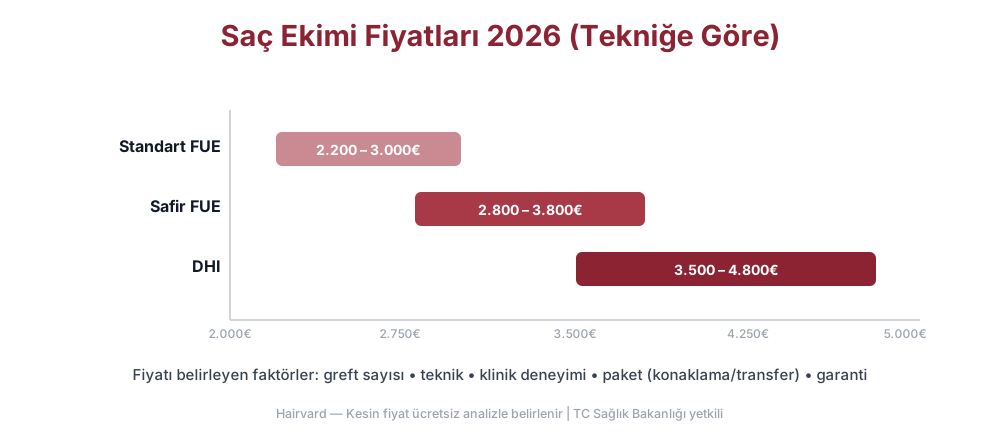
- Cost is the headline advantage: a full FUE or DHI transplant in Turkey typically costs EUR 2,200–4,800, compared with EUR 8,000–15,000+ in the UK, USA, or Germany for similar graft numbers.
- Experience and volume matter: Turkish clinics collectively perform hundreds of thousands of procedures a year, giving specialist teams unusually deep hands-on expertise.
- All-inclusive packages commonly bundle hotel stays, airport and clinic transfers, a translator, medications, and aftercare kits into the quoted price.
- Ministry of Health licensing is the single most important trust signal — verify it before booking anything.
- The savings are real, but so are the risks: unlicensed clinics, "ghost" surgeons, and over-harvesting exist. Due diligence protects you.
- Turkey's appeal is not just price but infrastructure built specifically around international hair transplant patients.
Why Turkey Leads the World in Hair Transplants
Turkey did not become the global capital of hair restoration by accident. Over the past 15 years, Istanbul in particular has developed an entire ecosystem around the procedure: dedicated clinics, trained surgical teams, hospitality services, and a regulatory framework overseen by the Turkish Ministry of Health. The result is a market where high volume drives down cost without necessarily lowering quality at reputable clinics.
For international patients, the appeal is straightforward. You receive a modern surgical procedure — most often FUE (Follicular Unit Extraction) or DHI (Direct Hair Implantation) — performed by teams who do this work every single day, at a price that makes the trip worthwhile even after flights and time off work. To understand the procedure itself before comparing destinations, see our guide on what a hair transplant is.
The Cost Advantage in Detail
The price gap is the reason most patients start looking abroad. The same number of grafts that costs EUR 12,000 in London or EUR 14,000 in California is routinely available in Istanbul for EUR 2,200–4,800. This is not because Turkish medicine is inferior — it reflects lower labour and facility costs, favourable exchange rates, and intense competition among a large number of clinics.
| Country | Typical Cost (2,500–3,500 grafts) | Approx. Cost per Graft | What's Usually Included |
|---|---|---|---|
| Turkey | EUR 2,200 – 4,800 | EUR 0.80 – 1.50 | Surgery, hotel, transfers, translator, aftercare |
| United Kingdom | EUR 8,000 – 15,000 | EUR 3.00 – 5.00 | Surgery only |
| United States | EUR 9,000 – 18,000+ | EUR 4.00 – 8.00 | Surgery only |
| Germany | EUR 7,000 – 14,000 | EUR 3.00 – 6.00 | Surgery only |
The difference is even larger than the headline numbers suggest, because Western prices rarely include accommodation or transfers, while Turkish package prices usually do. For a full breakdown of what drives the final figure, read our detailed hair transplant cost in Turkey guide.
Experience, Volume, and Technology
High patient volume has a genuine clinical benefit: repetition builds skill. Surgical teams at established Turkish clinics may assist on multiple procedures a day, accumulating experience with a wide range of hair types, loss patterns, and skin tones. This breadth is harder to find in markets where a surgeon performs only a handful of transplants a month.
Technology has kept pace. Reputable Turkish clinics use the same modern techniques found anywhere in the world:
- FUE (Follicular Unit Extraction) — individual follicular units are extracted and implanted, leaving no linear scar.
- DHI (Direct Hair Implantation) — grafts are placed with a Choi implanter pen, allowing dense, precise implantation.
- Sapphire FUE — a variation using sapphire-tipped blades to open finer recipient channels.
No technique is universally "best"; the right choice depends on your hair characteristics, the size of the area, and your goals. A good clinic recommends a method based on your case, not on what it wants to sell. Whether you are even a suitable candidate is worth confirming first — see our overview of who is a good hair transplant candidate.
What's Inside a Turkey Hair Transplant Package
One reason Turkey feels so accessible is the all-inclusive package model. Rather than paying separately for surgery, a hotel, and getting around the city, most reputable clinics quote a single price covering the whole trip. This removes hidden costs and simplifies planning for someone travelling from abroad.
| Package Element | Typically Included | Notes |
|---|---|---|
| Surgical procedure | Yes | FUE, DHI, or Sapphire FUE as agreed |
| Pre-op blood tests | Yes | Required for patient safety |
| Hotel accommodation | Yes (usually 2–3 nights) | Often 4–5 star, near the clinic |
| Airport & clinic transfers | Yes | VIP transport in most packages |
| Translator / patient host | Yes | English and other languages |
| Medications & aftercare kit | Yes | Shampoo, lotions, painkillers |
| PRP or add-on treatments | Sometimes | Confirm before booking |
| Follow-up support | Yes | Often 12 months of remote follow-up |
Always ask for the package contents in writing. A transparent clinic will happily itemise exactly what your fee covers and what it does not.
The Medical Tourism Process, Step by Step
Travelling abroad for surgery sounds daunting, but the process at an organised clinic is highly structured. Here is what a typical journey looks like from first contact to final results.
- Free online consultation. You send photos of your scalp and answer questions about your health and hair loss history. The clinic estimates the graft count and recommends a technique.
- Quote and planning. You receive a price, package details, and available dates. Nothing should be rushed or pressured.
- Travel and arrival. You fly to Istanbul; the clinic's driver meets you at the airport and takes you to your hotel.
- Pre-operative assessment. On procedure day, blood tests are performed and the surgeon designs your hairline with you.
- The procedure. Under local anaesthesia, grafts are extracted and implanted over roughly 6–8 hours, with breaks.
- First wash and instructions. The next day the clinic performs the first wash and teaches you aftercare.
- Return home. You fly back, usually 2–3 days after surgery, with medications and a written aftercare plan.
- Remote follow-up. Over the following 12 months, the clinic monitors your progress and answers questions.
The full timeline to visible results is longer than the trip itself. Shedding is normal in the first weeks, new growth begins around months 3–4, and final density appears at 12–18 months.
How to Choose a Clinic (and Avoid the Wrong One)
This is where diligence pays off. The low-cost end of the market includes operations that cut corners on safety, use unlicensed premises, or let unqualified technicians perform the entire surgery without a doctor present. The following checklist helps you separate a serious clinic from a risky one.
| Checklist Item | Why It Matters | Green Flag |
|---|---|---|
| Ministry of Health licence | Legal requirement in Turkey | Licence number provided on request |
| Surgeon involvement | Doctor must lead the procedure | Named specialist oversees your case |
| Transparent pricing | Avoids surprise charges | Written, itemised quote |
| Realistic promises | No clinic can guarantee outcomes | Honest, cautious language |
| Hygiene & facilities | Prevents infection | Accredited hospital or clinic setting |
| Aftercare | Recovery needs support | Structured 12-month follow-up |
| Clear communication | You must understand everything | Responsive, in your language |
Warning signs to avoid: prices that seem impossibly low, refusal to name the operating surgeon, guaranteed-result claims, pressure to pay a large deposit immediately, and no verifiable licence. If a clinic will not answer these questions clearly, walk away.
The Importance of Ministry of Health Licensing
In Turkey, hair transplant procedures may only be performed in facilities licensed by the Ministry of Health, under the responsibility of a qualified physician. This licence is not a formality — it is your primary legal and medical safeguard. A licensed clinic operates in an inspected facility, follows hygiene and safety standards, and employs medically qualified staff. Hairvard is fully licensed by the Turkish Ministry of Health, and you are entitled to ask any clinic to confirm its licence before you commit.
Understanding the Risks Honestly
No surgery is risk-free, and it would be dishonest to pretend otherwise. The good news is that the most common problems associated with hair transplant tourism come from choosing a poor clinic — not from the procedure itself.
| Risk | Cause | How to Avoid It |
|---|---|---|
| Infection | Poor hygiene or aftercare | Choose a licensed, accredited facility |
| Unnatural hairline | Inexperienced planning | Confirm surgeon designs the hairline |
| Over-harvesting | Taking too many grafts from the donor area | Choose a clinic that protects donor density |
| Poor growth | Graft mishandling | Verify surgical team experience |
| Complications abroad | No follow-up plan | Insist on structured remote aftercare |
When medications such as minoxidil or finasteride are recommended to support your results, they should only be used under medical supervision, as they carry their own considerations and are not suitable for everyone. A responsible clinic will explain this rather than hand them out casually.
The realistic picture is this: for a healthy candidate at a reputable, licensed Turkish clinic, a hair transplant is a well-established procedure with a strong safety record. The risks are real but largely avoidable through careful clinic selection.
Is Turkey Right for You?
Turkey offers a compelling combination of affordability, experience, and convenience that is genuinely hard to match elsewhere. For many international patients, it makes a procedure financially possible that would be out of reach at home. But the same market that produces excellent clinics also contains a few that should be avoided, so the value you get depends entirely on the choices you make.
If you approach it the right way — verifying licensing, insisting on surgeon involvement, demanding transparent pricing, and confirming aftercare — Turkey can offer world-class hair restoration at a fraction of Western prices. The best first step is a professional assessment of your individual case.
Frequently Asked Questions
Why is a hair transplant so much cheaper in Turkey?
Lower labour and facility costs, favourable exchange rates, and strong competition among many clinics keep prices down. It does not mean lower quality at reputable, licensed clinics — it reflects local economics, not inferior medicine.
Is it safe to get a hair transplant in Turkey?
At a Ministry of Health-licensed clinic with a qualified surgeon, yes — it is a well-established procedure with a strong safety record. Safety depends heavily on choosing the right clinic and following aftercare instructions.
How long do I need to stay in Turkey?
Most patients stay 2–3 nights. The procedure takes one day, the first wash and check-up happen the next day, and you typically fly home shortly after.
What is included in an all-inclusive package?
Packages usually include the surgery, pre-op blood tests, hotel accommodation, airport and clinic transfers, a translator, medications, an aftercare kit, and remote follow-up. Always confirm the contents in writing.
FUE or DHI — which technique is better?
Neither is universally better. FUE suits many cases and leaves no linear scar; DHI allows very precise, dense placement. The right method depends on your hair type, the treatment area, and your goals.
How do I verify a clinic's Ministry of Health licence?
Ask the clinic directly for its licence and the name of the responsible physician. A legitimate clinic will provide this without hesitation. Refusal is a serious warning sign.
Will the results look natural?
Results at an experienced clinic can look very natural, but no ethical clinic guarantees a specific outcome. Natural results depend on hairline design, graft placement, and your individual healing.
What are the biggest risks to watch for?
Infection, an unnatural hairline, over-harvesting of the donor area, and poor graft survival — nearly all of which trace back to choosing an unlicensed or inexperienced clinic. Careful selection is your best protection.
Do I need to speak Turkish?
No. Reputable clinics that serve international patients provide a translator or English-speaking patient host throughout your stay, from arrival to the follow-up period.
How much does a hair transplant in Turkey cost?
Typically EUR 2,200–4,800, depending on the number of grafts, the technique, and the package. This usually includes accommodation and transfers, unlike quotes in most Western countries.
When will I see the final results?
Shedding is normal in the first weeks. New growth usually begins around months 3–4, with final density appearing at roughly 12–18 months after the procedure.
Are medications like minoxidil or finasteride necessary?
They are sometimes recommended to support results, but only under medical supervision. They are not suitable for everyone and carry their own considerations, so they should never be taken casually.
Can I get a free assessment before deciding?
Yes. Hairvard offers a free hair analysis where a specialist reviews your photos and case, estimates graft numbers, and advises on suitability — with no obligation to book.
This article was medically reviewed by Ibrahim Yilmaz, Hair Transplant Specialist at Hairvard, a clinic licensed by the Turkish Ministry of Health in Atasehir, Istanbul. It is intended for general information and is not a substitute for a personal medical consultation. For a free, no-obligation hair analysis of your individual case, contact our team on +90 530 378 74 87.