

Eyebrows frame the face, shape expression, and quietly influence how balanced and rested a person looks. When they thin from years of plucking, over-waxing, scarring, or simply genetics, the whole face can seem softer or more tired than it should. An eyebrow transplant restores those brows permanently by moving healthy hair follicles from the back of your scalp into the brow area, one delicate graft at a time. It is widely considered the most technically demanding aesthetic transplant, because success depends less on how many grafts are placed and more on the precise angle, direction, and design of every single hair. At Hairvard in Atasehir, Istanbul, specialist Ibrahim Yilmaz performs eyebrow restoration using the DHI method with single-hair grafts, prioritizing a natural, understated result over an artificially dense line. This guide explains exactly what the procedure involves, who it suits, how it heals, and what a realistic outcome looks like.
Key Takeaways
- An eyebrow transplant is permanent: transplanted follicles come from the scalp and are genetically resistant to the thinning that affects the original brow, so results are long-lasting.
- It is the most delicate transplant because every hair must be placed at an extremely flat angle and in a specific direction to mimic natural brow growth.
- DHI with single-hair grafts is the standard technique for brows, giving the surgeon full control over depth, angle, and one-hair-at-a-time placement.
- Most brows need 150 to 400 grafts per side depending on the gap being filled, using individual hairs rather than the two-to-three-hair groups used on the scalp.
- Initial shedding is normal: transplanted hairs fall out within 2 to 4 weeks, then regrow permanently from month 3 to 4, with full results by roughly month 8 to 12.
- Transplanted brow hair behaves like scalp hair and will keep growing, so it needs occasional trimming and light grooming to stay in shape.
What Is an Eyebrow Transplant?
An eyebrow transplant is a minimally invasive procedure that relocates your own hair follicles from a donor area, usually the back or side of the scalp, into the eyebrow region to create or restore fuller, natural-looking brows. It uses the same follicular unit principles as scalp restoration but applies them on a far smaller and more exacting scale. If you are new to the concept of moving follicles from one area to another, our overview of what a hair transplant is explains the underlying biology that makes any of this possible.
The core idea is simple: hair from the donor zone is genetically programmed to keep growing for life, and it retains that programming even after being moved. The challenge is that eyebrow hair is not like scalp hair. Scalp hairs grow long and stand up; brow hairs are short, fine, and lie almost flat against the skin in a very particular fan pattern. The surgeon's job is to make transplanted scalp hairs behave and look like brow hairs, which is entirely about design and placement rather than sheer graft numbers.
Because the eyebrow is small, highly visible, and central to facial expression, there is no room for error. A single hair placed at the wrong angle stands out immediately, which is why this procedure is regarded as the benchmark test of a transplant specialist's precision.
Who Is a Good Candidate?
Eyebrow transplants suit a wide range of people whose brows have lost density or shape and cannot recover on their own. The most common reasons brows thin permanently include years of aggressive plucking, threading, or waxing that damages the follicle; scarring from accidents, burns, surgery, or piercings; medical conditions and certain treatments; and simple genetic sparseness that no amount of serum will fix.
Good candidates generally share a few traits: they have a healthy scalp donor area, realistic expectations, and brows that are thin or patchy rather than completely defined already. People who want to reduce or stop relying on daily brow pencil, microblading touch-ups, or tinting are often strong candidates, because a transplant offers a permanent alternative to those maintenance routines.
| Candidate Situation | Suitability | Notes |
|---|---|---|
| Over-plucked or over-waxed brows | Excellent | Very common reason; follicles often permanently damaged |
| Scarred brows (injury, burn, surgery) | Excellent | Restores hair across scar tissue with careful planning |
| Naturally sparse or thin brows | Excellent | Genetic sparseness responds well to design |
| Thinning from age | Good | Assessed case by case for donor quality |
| Active scalp or skin disease | Not yet | Condition must be stable before surgery |
| Unrealistic density expectations | Needs counseling | Natural look prioritized over artificial thickness |
The best way to know for certain is a personal assessment. Ibrahim Yilmaz reviews your brow shape, skin, and donor supply to confirm whether a transplant will give you the result you want before anything is scheduled.
Why the Eyebrow Is the Most Delicate Area
Every transplant demands skill, but the eyebrow concentrates the difficulty into a tiny space where mistakes cannot hide. Three factors make it uniquely delicate: angle, direction, and design.
Angle matters because brow hairs emerge almost parallel to the skin, at roughly 10 to 20 degrees, far flatter than scalp hairs. If a graft is placed too upright, the hair sticks out or grows in the wrong plane and looks obviously transplanted. Direction matters because a natural brow is not a single line of parallel hairs; the hairs point in changing directions across the brow. At the head of the brow (nearest the nose) they sweep upward, along the body they angle outward and slightly down, and at the tail they fan out toward the temple. Design ties it together: the overall shape must suit your bone structure, eye spacing, and gender, avoiding any look that is too thick, too arched, or too flat.
Because of these demands, the eyebrow is placed one hair at a time, and the surgeon must constantly change the angle and direction with almost every graft. This is very different from scalp work, where large zones share a similar growth direction.
| Feature | Eyebrow Hair | Scalp Hair |
|---|---|---|
| Growth angle | Very flat (10–20°) | Steeper (40–60°) |
| Hairs per graft | Single hair | 1–4 hairs |
| Direction | Changes across the brow | Consistent within a zone |
| Hair length | Short, needs trimming | Grows long naturally |
| Margin for error | Extremely low | Moderate |
Technique: Why DHI and Single-Hair Grafts
For eyebrows, Hairvard uses the DHI (Direct Hair Implantation) method with single-hair grafts. DHI uses a fine implanter pen (a Choi implanter) that holds one follicle and places it directly into the skin in a single motion, letting the surgeon set the exact depth, angle, and direction as each hair goes in. This level of control is exactly what a brow needs.
Single-hair grafts are essential because natural brows, particularly at the edges, are made of individual hairs. Placing two- or three-hair grafts, as is often done on the scalp, would create a tufted, doll-like look. By selecting and implanting one hair at a time, the surgeon can build density gradually and keep every hair pointing the right way.
The donor hair is typically taken from the nape or above the ears, where hairs tend to be finer and closer in caliber to brow hair. Choosing the right donor hair, thin rather than coarse, is part of what makes the result look believable. If you are also considering facial hair work, the same single-hair precision principles apply to a beard transplant, which shares much of the artistry involved in brow design.
| Technique Element | Purpose in Eyebrow Work |
|---|---|
| DHI implanter pen | Controls angle, depth, and direction per hair |
| Single-hair grafts | Recreates fine, natural brow edges |
| Fine donor hair selection | Matches brow caliber, avoids coarse look |
| No stitches or linear scar | Donor closes as tiny dots, heals discreetly |
| Custom brow mapping | Design tailored to face before implantation |
Designing a Natural Brow
Design is where an eyebrow transplant is won or lost, and it happens before a single graft is placed. Together you and the specialist map the new brow with a washable pencil, checking the shape from the front and side, at rest and while making expressions. A good design respects three landmarks: the brow should begin roughly in line with the side of the nose, peak (its highest arch) around two-thirds of the way out, and taper to a fine tail that ends at a diagonal line from the nose past the outer eye corner.
The design must also suit the individual. Men generally need flatter, straighter, fuller brows with minimal arch, while women's brows are often slightly more arched and tapered, though the goal is always to match the person rather than a trend. Facial symmetry is considered carefully, because natural brows are usually close but never perfectly identical, and a transplant that is too symmetrical can look artificial.
Only once you both approve the shape does implantation begin, following the mapped outline hair by hair. This collaborative planning stage is why an in-person or detailed remote consultation matters so much for brow work.
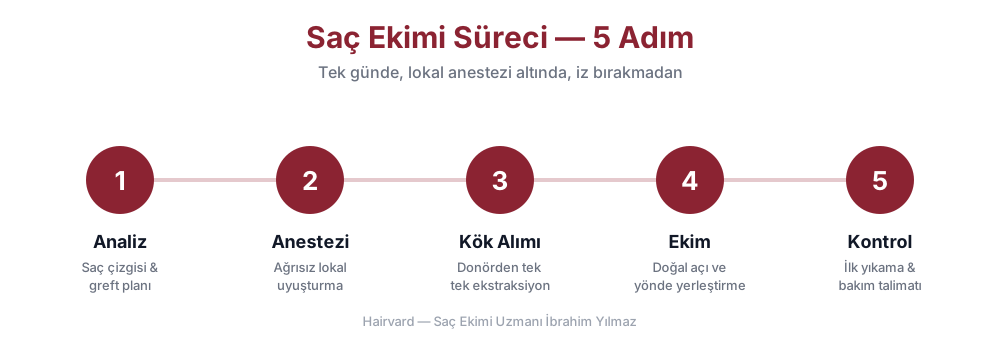
The Procedure Step by Step
An eyebrow transplant is an outpatient procedure performed under local anesthesia, so you are awake and comfortable throughout and go home the same day. The process is meticulous rather than lengthy, usually taking two to four hours depending on the number of grafts.
- Consultation and design. Your brow shape is mapped and agreed, and graft numbers are estimated.
- Donor preparation. A small area of the scalp is trimmed and numbed; you will not have a visibly shaved head.
- Graft extraction. Individual follicles are harvested one by one using the FUE method, leaving only tiny dot-like openings that heal without a linear scar.
- Graft preparation. Follicles are inspected under magnification and the finest single hairs are selected for the brow.
- Implantation. Using the DHI implanter, each hair is placed at the planned angle and direction along the design.
- Aftercare briefing. You receive detailed instructions and go home the same day.
Discomfort during the procedure is minimal thanks to local anesthesia, and most patients are surprised by how manageable the experience is. Because Hairvard is licensed by the Turkish Ministry of Health, the procedure is carried out under regulated clinical standards.
Healing and the Regrowth Timeline
Recovery from an eyebrow transplant is quick compared with the wait for final results. Understanding the timeline prevents unnecessary worry, especially during the shedding phase, which alarms people who were not warned about it. For a broader view of how transplanted hair heals over time, see our full hair transplant recovery timeline.
In the first few days, tiny crusts form around each implanted hair and the brow area may look slightly red or swollen. These crusts fall away within about a week, and most people are socially presentable quickly, though the brows will look temporarily fuller than the final result while the original transplanted hairs are still in place.
Then comes the crucial part: initial shedding. Between weeks two and four, the transplanted hairs fall out. This is completely normal and expected. The follicle stays alive under the skin; only the visible hair shaft is shed. From around month three to four, new hairs begin to grow from those follicles, and these are the permanent brow hairs. Growth continues to thicken and mature until roughly month eight to twelve, when the final result is visible.
| Timeframe | What Happens | What You See |
|---|---|---|
| Days 1–7 | Crust formation, mild redness | Slightly full, healing brows |
| Weeks 2–4 | Initial shedding of transplanted hairs | Brows thin out; this is normal |
| Months 3–4 | New permanent hairs start growing | Early regrowth appears |
| Months 5–8 | Progressive thickening | Brows fill in and gain shape |
| Months 8–12 | Final maturation | Complete, natural result |
Results, Permanence, and Maintenance
Once the transplanted hairs have grown in, they are permanent because they keep the genetic characteristics of their scalp origin. That origin has one practical consequence: scalp hair grows longer than brow hair, so transplanted brow hairs will need regular trimming, usually every one to two weeks, to keep them at brow length. Many people also brush them into place with a little gel or brow soap, especially in the early months as the hairs settle into their intended direction.
The result should look natural rather than obviously enhanced. A well-designed transplant does not aim for maximum thickness; it aims for brows that suit your face and that no one can identify as transplanted. Density can be built further with a second small session later if you want more fullness, but many patients are satisfied after one procedure.
It is worth being honest about outcomes: individual results vary with skin type, donor quality, and how carefully aftercare is followed, and no ethical clinic can guarantee a specific density. What a skilled specialist can offer is careful design, precise placement, and realistic expectations.
Frequently Asked Questions
How many grafts does an eyebrow transplant need?
Most eyebrows require between 150 and 400 grafts per side, using single-hair grafts. The exact number depends on how sparse the brow is, the shape being created, and your natural hair caliber. A full reconstruction of an absent brow needs more grafts than filling small gaps in an existing one.
Is an eyebrow transplant permanent?
Yes. Because the follicles come from the scalp donor area, they retain their genetic resistance to thinning and continue to grow for life. After the initial shedding and regrowth phase, the new brow hairs are permanent.
Does an eyebrow transplant hurt?
The procedure is performed under local anesthesia, so you feel little to no pain during it. Some patients report mild tenderness or tightness for a day or two afterward, which is easily managed and usually needs nothing stronger than simple pain relief.
Will the transplanted brow hairs look natural?
When the design, angle, and direction are done well, the result looks completely natural. This is precisely why single-hair grafts and the DHI method are used, and why the design stage is treated as the most important part of the whole process.
Why do the transplanted hairs fall out first?
Initial shedding is a normal response to transplantation. The hair shaft sheds while the follicle stays alive and dormant beneath the skin, then produces a new, permanent hair from around month three to four. It is expected and not a sign of failure.
How long until I see the final result?
Early regrowth begins around month three to four, with meaningful fullness by months five to eight. The final, mature result is generally visible by month eight to twelve as the hairs thicken and settle into their direction.
Do I need to trim my new eyebrows?
Yes. Since the transplanted hairs originate from the scalp, they grow longer than natural brow hair and need trimming roughly every one to two weeks. This is a minor, ongoing part of maintaining the result.
Will there be scarring in the donor area?
No linear scar is left. The FUE extraction method removes follicles individually, leaving only tiny dot-like marks in the scalp that fade and are hidden by surrounding hair. Nothing is visible once the area heals.
Can an eyebrow transplant fix scars in the brow?
Yes. Transplanting hair into scar tissue from injury, burns, surgery, or piercings is one of the most rewarding uses of the procedure, though scarred skin is assessed carefully beforehand because its blood supply can affect how grafts take.
Is an eyebrow transplant suitable for men?
Absolutely. Men often seek fuller, straighter brows with minimal arch, and the same single-hair DHI technique applies. The design is simply tailored to a masculine brow shape rather than a more arched one.
Can I still get microblading or use makeup afterward?
Once healed, you can groom or lightly make up your brows as you wish, though many people find they no longer need microblading or daily pencil once the transplant has grown in. Any cosmetic tattooing should wait until healing is complete.
How is an eyebrow transplant different from a beard transplant?
Both rely on single-hair precision and careful direction, but the brow is smaller, more visible, and uses even flatter angles. The artistry overlaps, which is why the same design principles used for a beard transplant also guide brow work.
What is the price of an eyebrow transplant at Hairvard?
Hairvard's procedures fall within a range of EUR 2,200 to 4,800, with the exact figure depending on graft numbers and the complexity of the design. A personalized quote is given after your brow assessment.
Can I combine an eyebrow transplant with other procedures?
Yes, eyebrow work is often combined with other restoration in the same visit when donor supply allows. Your specialist will advise whether combining procedures is appropriate for your donor area and goals.
This article was medically reviewed and confirmed by specialist Ibrahim Yilmaz at Hairvard, Atasehir, Istanbul. Every eyebrow is different, and the only way to know your ideal design and graft count is a personal evaluation. We invite you to book a free, no-obligation brow analysis with our team, call us at +90 530 378 74 87 or request your assessment online, and let us help you decide whether an eyebrow transplant is right for you.