

Shock loss after a hair transplant is the temporary shedding of hair — either transplanted or existing native hair — in the weeks following surgery, caused by the physical stress of the procedure pushing follicles into a resting phase. It is a normal, expected, and almost always reversible part of healing: in the vast majority of cases only the visible hair shaft is shed while the living root stays intact beneath the scalp, so the same follicle regrows a new hair within a few months. Understanding why it happens, when it starts and ends, and how to tell normal shock loss from a genuine warning sign helps patients stay calm during the phase that worries them most.
Key Takeaways
- Shock loss (also called shock shedding or telogen effluvium) is temporary hair fall triggered by surgical stress, affecting both transplanted grafts and, sometimes, surrounding native hair.
- The root usually survives — only the hair shaft sheds. The follicle enters a resting phase, then produces a new hair, which is why regrowth follows.
- It typically starts 2–4 weeks after surgery and eases by month 3, overlapping with the "ugly duckling" phase before visible regrowth begins around months 3–4.
- Shock loss is normal and rarely a cause for worry. True permanent loss is uncommon and usually linked to advanced miniaturisation of native hair that was already weakening.
- You cannot fully prevent shock loss, but you can support recovery through gentle aftercare, good nutrition, avoiding trauma to the scalp, and sometimes physician-guided minoxidil.
- Final results appear at 12–18 months. Patience through the shedding phase is the single most important thing a patient can do.
What Is Shock Loss? A Clear Definition
Shock loss is the sudden but temporary shedding of hair after a hair transplant, medically described as a form of telogen effluvium — a shift of hair follicles from their active growth phase into a resting (telogen) phase in response to stress. The "stress" here is physical: the micro-incisions, local anaesthetic, handling of tissue, and temporary disruption of blood supply during surgery all signal follicles to pause. Rather than dying, most follicles simply release the hair they were holding and wait before growing a new one.
The key point international patients should hold onto is this: in typical shock loss, the follicle (the root) remains alive and functional. What you see falling out — on the pillow, in the shower, on a towel — is the dead keratin shaft, not the living structure that produces hair. This is why shock loss is described as temporary rather than permanent.
To understand the whole process, it helps to first understand what a hair transplant is and how follicles are moved and settle into their new location.
Why Does Shock Loss Happen? The Biology
Every hair on your head follows a cycle: anagen (growth), catagen (transition), and telogen (rest and shedding). At any moment, a healthy scalp has around 85–90% of hairs growing and 10–15% resting. Surgery disturbs this balance.
Three main factors push follicles into the resting phase after a transplant:
- Direct trauma to the recipient area. Creating channels for new grafts inflames the surrounding skin, which can shock nearby native hairs into shedding.
- Temporary reduction in blood supply. Newly placed grafts and disturbed tissue experience a brief drop in oxygen and nutrients while the scalp heals and revascularises.
- The general stress response. Anaesthesia, swelling, and the body's healing cascade all raise the proportion of follicles entering telogen.
Because these are stress responses rather than damage to the root, the follicles recover. The hair cycle simply resets and, after a resting period, resumes growth.
| Hair Cycle Phase | What Happens | Relevance to Shock Loss |
|---|---|---|
| Anagen (growth) | Follicle actively produces hair; lasts 2–7 years | Where healthy hair should be |
| Catagen (transition) | Follicle shrinks, growth stops; lasts 2–3 weeks | Brief bridge into resting |
| Telogen (rest) | Follicle dormant; hair loosens; lasts ~3 months | Surgical stress pushes hairs here |
| Exogen (shedding) | Old hair shaft is released | This is the visible shock loss |
Transplanted Hair vs Existing Hair: Two Kinds of Shock Loss
Patients are often surprised to learn that shock loss affects two different populations of hair, and it helps to keep them separate.
Shedding of transplanted grafts
Almost every transplanted hair sheds in the first weeks — this is expected and near-universal. The graft (the follicle) survives the move and beds into the scalp, but the hair shaft it was carrying falls out. New hairs then grow from those same grafts over the following months. This shedding is a sign the process is proceeding normally, not that grafts have failed.
Shock loss of existing (native) hair
Surrounding native hair — especially thinning, miniaturised hair near the recipient zone — can also shed in response to the surgical stress nearby. This is the type patients notice most because it can make the area look temporarily thinner than before surgery. In the large majority of cases this native hair regrows. The exception is native hair that was already deep in the miniaturisation process and near the end of its lifespan; that hair may not fully return, but its loss was largely already underway.
| Feature | Transplanted Hair Shock Loss | Native Hair Shock Loss |
|---|---|---|
| How common | Near-universal (expected) | Common but variable |
| What sheds | The shaft; graft/root stays | The shaft; root usually stays |
| Regrowth | Yes, from month 3–4 | Usually yes, unless already miniaturised |
| Reason for concern | None — it is expected | Rarely; monitor if extensive |
| Permanent risk | Very low | Low; higher only for weak native hair |
When Does Shock Loss Start and End? The Timeline
Timing is the question patients ask most, because the uncertainty is the hardest part. While every individual differs, the pattern is fairly predictable.
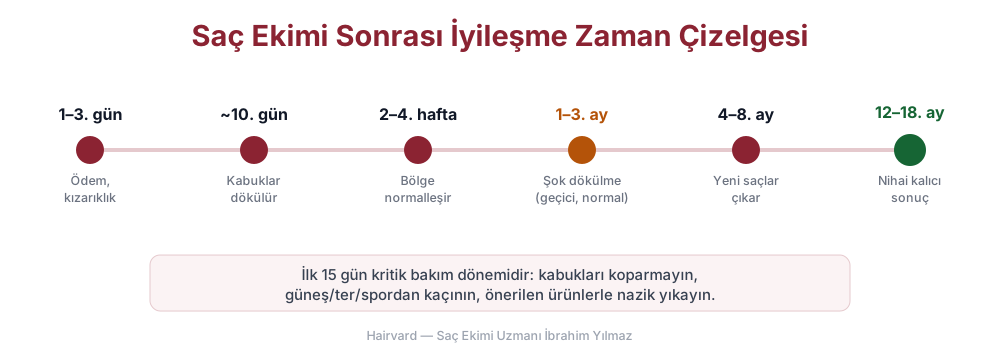
Shock loss usually begins around 2–4 weeks after surgery and is often most noticeable between weeks 3 and 6. It then eases and resolves by around the 3-month mark, blending into the low point known as the "ugly duckling" phase. Visible regrowth typically starts at months 3–4, thickens through months 6–9, and reaches final density at 12–18 months.
| Time After Surgery | What Is Typically Happening |
|---|---|
| Days 1–14 | Healing, scabbing, redness; grafts settling |
| Weeks 2–4 | Shock loss begins; transplanted shafts start to shed |
| Weeks 4–8 | Peak shedding of transplanted and some native hair |
| Month 3 | Shedding resolves; scalp at its thinnest ("ugly duckling") |
| Months 3–4 | New hair begins to emerge, often fine and light |
| Months 6–9 | Noticeable thickening and coverage |
| Months 12–18 | Final density, texture, and result |
For a fuller month-by-month breakdown of the whole healing journey, see the hair transplant recovery timeline.
Is Shock Loss Normal? When to Worry and When Not To
For the overwhelming majority of patients, shock loss is completely normal and not a reason for concern. It is a predictable stage, and its presence often signals that the natural hair cycle is resetting as expected. The most reassuring fact is that shedding of the shaft says nothing about whether the follicle survived — and in typical cases, it did.
That said, it is worth knowing the difference between expected shedding and signs that merit a conversation with your clinic.
| Normal Shock Loss | Signs to Raise With Your Clinic |
|---|---|
| Diffuse thinning of transplanted and nearby hair | Widening bald patches with a sharp, defined edge |
| Starts 2–4 weeks post-op, eases by month 3 | Shedding that keeps worsening past 4–5 months |
| No pain, no pus, no unusual redness | Pain, discharge, foul smell, or spreading redness |
| Scalp otherwise healing normally | Signs of infection or graft displacement |
| Regrowth visible by months 3–4 | No regrowth at all by months 6–8 |
If you see the signs in the right-hand column — particularly infection signs or a total absence of regrowth beyond month 6–8 — contact your clinic. These are uncommon, but they are the situations where prompt attention matters.
Does Shock Loss Mean the Transplant Failed?
No. This is the single most important reassurance for anxious patients. Shedding of transplanted hair is not graft failure — the graft is the follicle, and it remains anchored in the scalp even after the visible hair falls out. Graft survival is determined by the health of the follicle and the quality of the placement, not by whether the temporary shaft sheds.
Genuine graft failure is uncommon in the hands of an experienced team and shows up differently — typically as an area that never produces any regrowth by month 8–12, rather than as early shedding. If your grafts shed at week 3, that is the process working as designed.
What Reduces or Supports Recovery From Shock Loss?
You cannot completely prevent shock loss — it is an inherent stress response to surgery — but you can create the best possible conditions for follicles to recover and regrow. The goal is to reduce additional stress on the scalp and support follicle health.
Gentle, correct aftercare
- Follow your clinic's washing instructions precisely, especially in the first two weeks.
- Avoid rubbing, scratching, or picking at scabs, which can dislodge grafts.
- Sleep with your head elevated for the first several nights to reduce swelling.
- Avoid hats that press on grafts until your clinic clears them.
Protect the scalp from extra stress
- No strenuous exercise, saunas, or heavy sweating for the period your clinic specifies.
- Avoid direct sun on the healing scalp; UV stress is unhelpful during recovery.
- Do not colour, bleach, or use harsh styling products until fully healed.
Support follicle health
- Eat a protein-rich, balanced diet; hair is built largely from protein (keratin).
- Ensure adequate iron, zinc, vitamin D, and B vitamins — deficiencies worsen shedding.
- Stay hydrated and prioritise sleep, both of which support the healing cascade.
- Minoxidil may be recommended by some physicians to support surrounding native hair and shorten the resting phase — but only use it if your surgeon advises it, as timing matters.
| Supportive Measure | Why It Helps | When to Start |
|---|---|---|
| Gentle washing routine | Prevents graft loss and inflammation | As instructed (often day 2–3) |
| Protein and micronutrients | Builds hair and supports follicles | Immediately and ongoing |
| Avoiding heat/sweat/sun | Reduces additional follicle stress | First 2–4 weeks minimum |
| Physician-guided minoxidil | May support native hair, shorten telogen | Only when surgeon advises |
| Adequate sleep and low stress | Supports overall hair cycle recovery | Throughout recovery |
The technique used in your procedure can also influence the recipient-area trauma. If you are still choosing a method, our comparison of FUE vs DHI hair transplant explains how channel creation and graft placement differ between the two.
When Does Regrowth Happen After Shock Loss?
Once the resting phase ends, follicles re-enter the growth cycle and begin producing new hair. In practical terms, new growth usually becomes visible 3–4 months after surgery. These first hairs are often fine, thin, and lightly pigmented — sometimes called "baby hairs" — and they thicken and darken over the following months.
A realistic mental model of the growth curve:
- Months 3–4: first sprouts appear; coverage still patchy.
- Months 5–6: density visibly improves; hair strengthens.
- Months 7–9: most of the transformation becomes apparent.
- Months 12–18: final density, calibre, and styling potential.
Because this process is gradual, comparing week-to-week is misleading. Monthly photos in consistent lighting are far more useful for tracking genuine progress and reassuring yourself that regrowth is on track.
How Common Is Native-Hair Shock Loss, Really?
Native-hair shock loss varies widely between individuals and depends heavily on how much thinning already existed. Patients with substantial healthy native hair around the recipient area tend to experience less noticeable native shedding, while those with extensive pre-existing miniaturisation may see more — because that weak hair is more easily tipped into telogen. In both cases, healthy native follicles typically recover; only follicles that were genetically destined to be lost soon may not return. This is why an honest pre-operative hair analysis, which maps the health of your existing hair, is so valuable in setting expectations.
Practical Do's and Don'ts During the Shock Loss Phase
| Do | Don't |
|---|---|
| Follow aftercare instructions exactly | Panic when hair sheds at weeks 2–6 |
| Eat well and stay hydrated | Start minoxidil without surgeon approval |
| Take monthly progress photos | Compare yourself week to week |
| Contact your clinic about infection signs | Pick, scratch, or rub the grafts |
| Be patient through the "ugly duckling" phase | Expect final results before 12 months |
| Sleep and manage general stress | Use harsh chemicals or heat on the scalp |
Frequently Asked Questions
What exactly is shock loss after a hair transplant?
Shock loss is the temporary shedding of transplanted and sometimes surrounding native hair in the weeks after surgery, caused by the physical stress of the procedure pushing follicles into a resting phase. The root usually survives, so the hair regrows.
Is shock loss normal, or does it mean something went wrong?
It is completely normal and expected. In most cases it is a sign that the hair cycle is resetting as it should, and it does not indicate that grafts have failed or that the procedure went wrong.
When does shock loss usually start?
It typically begins around 2–4 weeks after surgery and is often most noticeable between weeks 3 and 6, though the exact timing varies by individual.
When does shock loss stop?
Shedding generally eases and resolves by around the 3-month mark, blending into the "ugly duckling" phase before new regrowth begins at months 3–4.
Will my transplanted hair grow back after it sheds?
Yes. The transplanted follicle stays in the scalp when the shaft sheds, and it produces a new hair over the following months, with visible growth typically starting at 3–4 months.
Does shock loss mean my grafts have died?
No. Shedding of the hair shaft is not graft failure — the graft is the living follicle, which remains anchored in the scalp. Genuine failure appears as an absence of regrowth by month 8–12, not as early shedding.
Can shock loss affect my existing (native) hair too?
Yes. Native hair near the recipient area can shed from the surgical stress. It usually regrows, though hair that was already heavily miniaturised may not fully return.
Is native-hair shock loss permanent?
Usually not. Healthy native follicles recover and regrow. The only hair that may not return is hair that was already near the end of its lifespan due to advanced genetic thinning.
How can I prevent shock loss?
You cannot fully prevent it, as it is an inherent response to surgery. You can support recovery through gentle aftercare, good nutrition, avoiding scalp trauma and heat, and sometimes physician-guided minoxidil.
Should I use minoxidil to reduce shock loss?
Only if your surgeon recommends it. Minoxidil may help support native hair and shorten the resting phase for some patients, but timing relative to your surgery matters, so follow your clinic's guidance.
How much hair loss during this phase is too much?
Diffuse thinning that eases by month 3 is normal. Warning signs include sharply defined widening bald patches, shedding that worsens past 4–5 months, signs of infection, or no regrowth at all by months 6–8 — contact your clinic if you notice these.
When will I see my final results?
Final density and texture typically appear at 12–18 months. Regrowth is gradual, so tracking monthly photos in consistent lighting is the best way to see genuine progress.
Does the transplant technique affect shock loss?
The degree of recipient-area trauma can influence native-hair shock loss, and techniques differ in how channels are created and grafts placed. Our FUE vs DHI comparison explains these differences in detail.
This article was medically reviewed by Ibrahim Yilmaz, Hair Transplant Specialist at Hairvard, a clinic in Atasehir, Istanbul licensed by the Turkish Ministry of Health. It is intended for general education and does not replace personalised medical advice; individual results and recovery vary. For a free, no-obligation hair analysis and honest guidance on your situation, you are warmly invited to contact our team at +90 530 378 74 87.