

If you have been researching why hair thins or disappears with age, one molecule comes up again and again: DHT, or dihydrotestosterone. It is the single most important hormonal driver of the most common form of hair loss in both men and women, yet it is widely misunderstood. Many people assume that having "too much testosterone" causes baldness, or that hair loss is purely about genes, or that a shampoo alone can neutralise the problem. The reality is more specific and, once you understand it, far more useful. DHT is a hormone your body makes on purpose. In some tissues it is essential; on a genetically susceptible scalp it gradually shrinks hair follicles until they can no longer produce visible hair. This article explains what DHT actually is, how it forms, exactly how it affects your follicles, why the hair on the back and sides of your head largely resists it (the biological principle that makes hair transplantation possible), and what the honest, evidence-based options are for reducing its impact.
Key Takeaways
- DHT (dihydrotestosterone) is a potent androgen hormone converted from testosterone by an enzyme called 5-alpha reductase. It is not a "bad" hormone; it has essential roles in the body, but it also drives genetic hair loss.
- Genetic hair loss happens because certain follicles are sensitive to DHT. DHT binds to receptors in those follicles and triggers miniaturisation — the follicle shrinks and produces progressively thinner, shorter, weaker hairs over several cycles.
- The nape and sides of the scalp (the donor area) are genetically DHT-resistant, which is why hair there tends to last a lifetime and why it is the hair used in a transplant.
- Higher testosterone does not mean more hair loss. What matters is follicle sensitivity, 5-alpha reductase activity, and genetics — not the absolute level of testosterone in your blood.
- DHT's effect can be reduced medically with finasteride (or dutasteride) under medical supervision, which lowers DHT by inhibiting 5-alpha reductase. These medications have real benefits and real potential side effects that must be discussed with a doctor.
- A hair transplant relocates DHT-resistant follicles into thinning areas; it treats the pattern but does not stop the underlying process in your original, non-transplanted hair.
What Is DHT?
DHT, short for dihydrotestosterone, is a sex hormone belonging to a group called androgens. Androgens are the hormones responsible for typically "male" physical characteristics, though both men and women produce them in differing amounts. DHT is derived from testosterone, but it is considerably more powerful: it binds to the same cellular receptors as testosterone, yet it attaches more tightly and activates them more strongly. By some estimates DHT is several times more potent than testosterone itself at the androgen receptor.
It is important to understand from the outset that DHT is not a defect or a poison. During foetal development it is essential for the formation of male genitalia. From puberty onwards it contributes to the deepening of the voice, the growth of facial and body hair, prostate development, and other secondary sexual characteristics. In other words, your body produces DHT deliberately and relies on it for normal physiology.
The paradox of DHT is that the very same hormone that grows hair on the face and body can shrink hair on the scalp. Whether DHT helps or harms a particular follicle depends almost entirely on the genetic programming of that follicle. This is the central idea behind androgenetic alopecia, better known as male pattern baldness, and it is why hair loss is so patterned and predictable rather than random.
How DHT Forms: Testosterone Plus 5-Alpha Reductase
DHT is not something you consume or absorb from outside; your body manufactures it from testosterone through a single enzymatic step. The enzyme responsible is 5-alpha reductase. When testosterone encounters this enzyme in certain tissues — the scalp, prostate, skin, and liver among them — a portion of it is converted into DHT.
There are two main types of 5-alpha reductase relevant to hair. Type 1 is found widely in the skin and sebaceous (oil) glands. Type 2 is concentrated in hair follicles, the prostate, and the genital area, and it is the type most strongly associated with pattern hair loss. This distinction matters because different medications target these enzyme types differently, which explains why finasteride and dutasteride behave slightly differently from one another.
The table below breaks the mechanism down step by step.
| Step | What happens | Where it occurs | Why it matters |
|---|---|---|---|
| 1. Testosterone production | The body produces testosterone (mainly in the testes, with smaller amounts from the adrenal glands and ovaries) | Testes, adrenal glands, ovaries | Provides the raw material for DHT |
| 2. Enzyme contact | Testosterone meets the enzyme 5-alpha reductase in target tissues | Scalp, skin, prostate, liver | The conversion point; more enzyme activity means more DHT |
| 3. Conversion to DHT | 5-alpha reductase converts testosterone into dihydrotestosterone | Locally, within the tissue | DHT is far more potent than testosterone at the receptor |
| 4. Receptor binding | DHT binds to androgen receptors inside follicle cells | Hair follicle | In sensitive follicles, this triggers the harmful signal |
| 5. Follicle response | Genetically sensitive follicles begin to miniaturise | Susceptible scalp regions | The visible thinning of pattern hair loss begins |
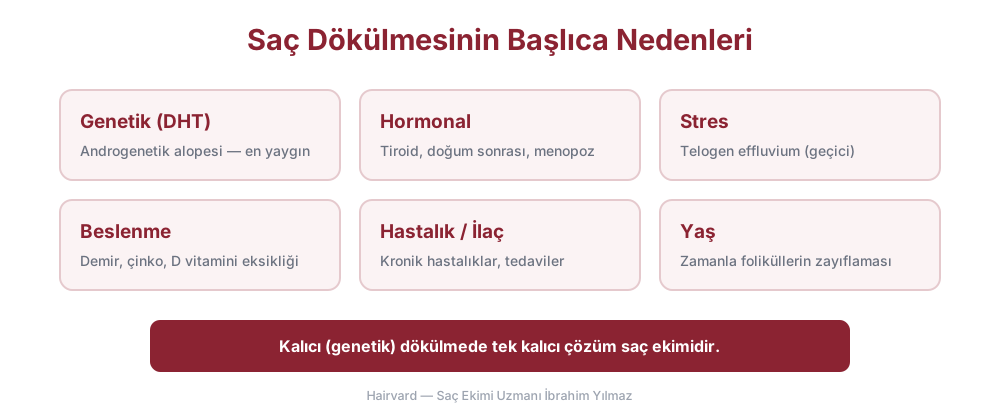
A crucial detail is that much of this activity is local. The DHT that damages a scalp follicle is often produced right there in the scalp tissue, not simply delivered by the bloodstream. This is why some topical approaches aim to influence DHT at the level of the skin, and why scalp follicle sensitivity — not just circulating hormone levels — governs the outcome. For a broader look at how hormones sit alongside other triggers, see our overview of the causes of hair loss.
How DHT Affects Hair Follicles: Miniaturisation
To understand how DHT causes hair loss, you first need to understand the hair growth cycle. Every follicle cycles through three main phases: anagen (the active growing phase, lasting years), catagen (a short transitional phase), and telogen (a resting phase, after which the hair sheds and a new one begins). In a healthy follicle, the anagen phase is long, so hairs grow thick and long before they are eventually replaced.
When DHT binds to androgen receptors in a genetically sensitive follicle, it disrupts this cycle in a characteristic way. It progressively shortens the anagen (growth) phase and lengthens the resting phase. With each successive cycle, the follicle produces a hair that is a little thinner, shorter, and lighter in colour than before. Over time, thick, pigmented "terminal" hairs are replaced by fine, barely visible "vellus" hairs. This gradual shrinking process is called miniaturisation, and it is the biological signature of androgenetic alopecia.
Miniaturisation is usually gradual and cumulative, which is why pattern hair loss creeps up over years rather than appearing overnight. It also explains why early intervention tends to be more effective: a follicle that has miniaturised but is still alive can sometimes recover, whereas a follicle that has been dormant for a very long time may eventually be lost entirely.
The following table shows what happens to a susceptible follicle as miniaturisation advances.
| Stage | Hair characteristic | Follicle status | Reversibility |
|---|---|---|---|
| Healthy terminal hair | Thick, long, pigmented | Full-sized, long anagen phase | Not applicable — healthy |
| Early miniaturisation | Slightly thinner, shorter | Anagen phase shortening | Often responsive to treatment |
| Advanced miniaturisation | Fine, wispy, lighter | Markedly shrunken, weak growth | Sometimes responsive if treated |
| Vellus transformation | Barely visible "peach fuzz" | Very small, minimal activity | Limited; harder to recover |
| Dormant / lost follicle | No visible hair | Inactive or gone | Generally not reversible |
It is worth emphasising an honest point here: no topical product or medication can reliably regrow hair from a follicle that is truly gone. Treatments work best on follicles that are still present but struggling. This is precisely why a hair transplant exists as an option — it reintroduces healthy follicles where the original ones can no longer perform.
Why the Nape and Sides Resist DHT: The Donor Logic
Here lies one of the most important and reassuring facts in the whole subject. In the overwhelming majority of people with pattern hair loss, the hair on the back and sides of the head — roughly the horseshoe-shaped band from the nape around to above the ears — is not sensitive to DHT. These follicles are genetically programmed differently from those on the top of the scalp. Even in a person whose crown and hairline have thinned dramatically, that lower band usually remains, sometimes for life.
This phenomenon is often described as "donor dominance." The theory, supported by decades of clinical observation, is that a follicle carries its own genetic instructions with it. A DHT-resistant follicle taken from the back of the head keeps its resistance even after it is moved to the top of the scalp. It does not "catch" the sensitivity of its new neighbourhood. This single biological fact is the entire foundation of modern hair transplantation.
The table below summarises the difference between the two zones.
| Feature | Top of scalp (crown, hairline, mid-scalp) | Back and sides (donor area) |
|---|---|---|
| DHT sensitivity | High in susceptible individuals | Typically very low / resistant |
| Long-term outlook | Prone to miniaturisation and loss | Usually stable for life |
| Genetic programming | Vulnerable to androgens | Protected from androgens |
| Role in transplantation | Recipient (thinning) area | Donor (harvest) area |
| Hair used for grafts? | No | Yes |
Because donor hair retains its resistance, follicles moved into a thinning crown or hairline continue to behave like donor hair in their new location — they are expected to keep growing long-term. This is why a well-planned transplant using genuinely DHT-resistant grafts can produce lasting results. It is also why surgeons assess your donor area so carefully before recommending surgery: the density, quality, and resistance of that reserve determine what is realistically achievable.
There is an important caveat to state plainly. A transplant redistributes DHT-resistant hair, but it does not switch off DHT or protect your original, non-transplanted hair on the top of the scalp. Native miniaturising hairs can continue to thin around transplanted ones. That is exactly why many clinicians recommend combining a transplant with ongoing medical therapy — to preserve the native hair you still have while the transplanted hair fills in the pattern.
How DHT Can Be Reduced
Because DHT is the driver of pattern hair loss, most medical treatments work by lowering DHT or by blocking its effect on the follicle. It is essential to be realistic here: reducing DHT can slow, halt, or partially reverse miniaturisation in follicles that are still viable, but it is not a cure, and results require consistent, long-term use. The moment effective treatment stops, DHT levels return to baseline and the hair loss process typically resumes.
Medical Options (Under Medical Supervision)
The best-established medical approach is a class of drugs called 5-alpha reductase inhibitors, which reduce the conversion of testosterone into DHT.
Finasteride blocks the type 2 enzyme and can lower scalp and serum DHT substantially. It is one of the most studied hair-loss medications in existence. You can read a dedicated explainer in our guide to what finasteride is. Finasteride must be taken under medical supervision. While many users tolerate it well, a minority report side effects that can include reduced libido, erectile difficulties, or mood changes. For most people these effects are reversible on stopping the drug, but they are real and must be weighed honestly with a doctor. It is not suitable for women who are or may become pregnant.
Dutasteride inhibits both type 1 and type 2 enzymes and can lower DHT even further. It is used for hair loss in some countries and carries a similar side-effect profile that, again, requires medical oversight.
Minoxidil, though frequently used alongside these drugs, works differently — it does not lower DHT. Instead it prolongs the growth phase and improves blood supply to the follicle. It is often combined with a DHT-reducing drug because the two act on different parts of the problem. Minoxidil should also be used under medical supervision, and it too must be continued to maintain its effect.
The table below compares the main options honestly.
| Approach | How it works | Effect on DHT | Key honest considerations |
|---|---|---|---|
| Finasteride | Inhibits type 2 5-alpha reductase | Lowers DHT significantly | Prescription only; possible sexual/mood side effects; not for pregnancy; must continue |
| Dutasteride | Inhibits type 1 and type 2 | Lowers DHT more strongly | Prescription only; similar side effects; medical oversight essential |
| Minoxidil | Prolongs growth phase, improves blood flow | No effect on DHT | Does not target the cause; must continue; possible shedding at first |
| Ketoconazole shampoo | May have mild local anti-androgen action | Minor local effect at most | Adjunct only; evidence modest; not a standalone solution |
Natural and Lifestyle Approaches
Many people prefer to ask about natural approaches first, and it is fair to discuss them honestly rather than overselling them. Certain foods and supplements — such as saw palmetto, pumpkin seed oil, green tea compounds, and zinc — have been studied for mild anti-androgen or 5-alpha reductase–inhibiting properties. Some small studies show modest benefit, particularly for saw palmetto, but the evidence is far weaker than for prescription medication, and effects are generally subtle.
More broadly, general health measures support the scalp environment even if they do not dramatically lower DHT: a balanced diet with adequate protein, iron and vitamin D; managing stress; sleeping well; and avoiding crash diets and smoking. These will not reverse genetic hair loss on their own, but poor nutrition and chronic stress can worsen shedding, so correcting them helps you get the most out of any treatment plan.
| Natural approach | Proposed mechanism | Honest assessment |
|---|---|---|
| Saw palmetto | Possible mild 5-alpha reductase inhibition | Some supporting studies; effect far weaker than finasteride |
| Pumpkin seed oil | Possible mild anti-androgen effect | Limited evidence; may offer modest support |
| Green tea (EGCG) | Antioxidant, possible follicle support | Preliminary evidence only |
| Zinc | Cofactor in hair and hormone metabolism | Helps mainly if you are deficient |
| Balanced diet, stress control, sleep | Supports overall follicle health | Does not stop genetic loss, but reduces avoidable shedding |
A sensible, honest summary is this: natural measures can be a reasonable complement, especially for those who cannot or prefer not to take medication, but anyone expecting them to match the results of prescription 5-alpha reductase inhibitors is likely to be disappointed.
Putting It Together: DHT, Treatment, and Transplantation
Understanding DHT clarifies why the different treatments exist and how they fit together. Medication reduces or blocks DHT to protect and partially restore follicles that are still viable, especially on the top of the scalp where they are under attack. A hair transplant takes advantage of the fact that donor follicles are DHT-resistant, relocating them to restore density where native follicles have already been lost. The two strategies are complementary rather than competing: medication defends your existing hair, while a transplant rebuilds areas that medication alone cannot.
For a patient, the practical path usually begins with an honest assessment: how advanced is the miniaturisation, how good is the donor reserve, and what are the person's goals, health status and preferences. From there a plan can combine medical therapy, lifestyle support, and — where appropriate — surgery. Because DHT never fully "switches off," any durable plan accounts for the fact that native hair may continue to change over the years.
Frequently Asked Questions
What is DHT in simple terms?
DHT (dihydrotestosterone) is a powerful male-type hormone made from testosterone. Your body needs it for normal development, but on a genetically sensitive scalp it gradually shrinks hair follicles and causes pattern hair loss.
Does high testosterone cause baldness?
No. This is one of the most common myths about hair loss. Baldness is not caused by having a high level of testosterone. What matters is how sensitive your follicles are to DHT, how active your 5-alpha reductase enzyme is, and your genetic inheritance. People with perfectly normal or even low testosterone can still experience significant pattern hair loss.
How does DHT actually cause hair to fall out?
DHT binds to receptors in genetically susceptible follicles and shortens their growth (anagen) phase. With each hair cycle the follicle produces a thinner, shorter hair until it eventually makes only fine, barely visible hair or none at all. This shrinking process is called miniaturisation.
Why doesn't the hair on the back of my head fall out?
The follicles on the nape and sides of the scalp are genetically DHT-resistant. They are programmed differently from the follicles on top, so DHT does not miniaturise them. This is why that hair usually lasts a lifetime and why it is used as donor hair in a transplant.
This article was medically reviewed and confirmed by Ibrahim Yilmaz, hair transplant specialist at Hairvard (Atasehir, Istanbul), licensed by the Turkish Ministry of Health. It is intended for general education and does not replace a personal medical consultation. If you would like to understand whether your hair loss is DHT-driven and what your realistic options are, Hairvard offers a free, no-obligation hair analysis. Our team will review your situation honestly — including whether medical therapy, a transplant, or simply monitoring is the most appropriate next step for you.