

The temples frame the entire upper face. When the temporal corners retreat, the front hairline can look intact from the mirror straight on, yet photographs from a slight angle reveal two widening gaps above and behind the outer edge of the eyebrows. This is temporal recession, one of the earliest visible signs of pattern hair loss and one of the more requested refinements at our clinic in Atasehir, Istanbul. A temple hair transplant rebuilds these recessed corners with individually placed grafts, restoring the soft triangular shape that makes a hairline read as youthful and natural.
Temple restoration is deceptively difficult. The angles are flat, the hairs are fine, and the direction changes across a very small area. Done well, it is invisible. Done carelessly, it looks pluggy or points the wrong way. This guide explains why the temporal region is technically demanding, how surgeons plan angle and direction, how many grafts it typically needs, and why women pursue this procedure as often as men. For broader background, see our overview of what a hair transplant involves.
Key Takeaways
- Temporal recession is the retreat of hair at the temple corners, forming an "M" or deepening the natural triangle above and behind the outer eyebrow.
- The temple is technically demanding because hairs are fine, single-follicle, flat-angled, and change direction over a very small surface.
- Angle and direction matter more here than almost anywhere else; temple hair typically lies nearly flat and points downward and slightly forward.
- Most temple cases use single-hair grafts, and graft counts are usually lower per side than for the frontal hairline.
- Women pursue temple transplants frequently, often to reshape a naturally high or thinning temple rather than to correct male-pattern loss.
- Realistic, natural density is the goal; no ethical clinic guarantees a specific cosmetic outcome.
- Any medications used to support the result, such as finasteride or minoxidil, are used only under medical supervision.
- Typical hair transplant pricing at our clinic ranges from EUR 2,200 to 4,800 depending on graft numbers and complexity.
What Is Temporal Recession?
The temporal region sits at the sides of the forehead, between the frontal hairline and the hair above the ears. In an unaffected adult, the hairline sweeps from the central forehead down into two gentle corners, then curves back toward the sideburn area. These corners, together with the small wedge of hair pointing toward the eye, are often called the temple triangle or temporal point.
As pattern hair loss begins, the corners are frequently the first zone to thin. The hairline appears to lift at the sides while the central forelock stays fuller, producing the familiar "M" shape. Because the change is gradual and off to the side, many people notice it first in photos taken at three-quarter angles or in bright overhead light rather than in a straight-on mirror.
Not all temple recession is disease-related. Some people are simply born with high or sparse temples, and the temple triangle naturally varies in shape from one face to another. Distinguishing inherited shape from progressive loss is part of the consultation, because it changes both the plan and the expectations.
Why the Corners Recede First
The follicles at the temporal corners tend to be among the more sensitive to the hormonal drivers of pattern loss. They also carry finer, shorter hairs than the mid-scalp, so even modest miniaturization becomes visible quickly. The result is that a relatively small amount of thinning at the temple produces a disproportionately large change in how the face is framed.
Why the Temple Is Technically Demanding
Surgeons often describe the temple as one of the true tests of artistry in hair restoration. Several features combine to make it harder than the central hairline.
First, the hair is fine. Temple hairs are usually thinner in caliber than frontal or crown hairs, and they almost always grow as single follicles. Placing a thick, multi-hair graft here would stand out immediately.
Second, the angle is extremely acute. While frontal hairline hairs may emerge at a moderate angle, temple hairs lie nearly flat against the skin, sometimes at only ten to twenty degrees. Recreating that flatness requires the recipient incisions to be made almost parallel to the scalp.
Third, the direction is not uniform. Across the temple, hair fans and sweeps, changing orientation over a few millimeters. The temporal point in particular can carry hair that points forward and downward, opposite to the backward sweep just above it.
Fourth, the margin for error is small. Because the area is compact and highly visible when the face is viewed from the side, a handful of misangled grafts can undermine the whole result.
| Temple challenge | Why it matters | How surgeons address it |
|---|---|---|
| Fine hair caliber | Thick grafts look unnatural | Use single-hair follicular units |
| Very acute angle | Flat-lying hair is the norm | Near-parallel recipient incisions |
| Changing direction | Hair fans across the zone | Map direction millimeter by millimeter |
| High visibility from the side | Errors show in profile | Conservative, irregular placement |
| Naturally soft density | Dense packing looks wrong | Graded, feathered density |
Angle, Direction, and the Natural Look
Angle and direction are the heart of a convincing temple result. The two terms are related but distinct. Angle refers to how steeply the hair exits the skin, from nearly flat to more upright. Direction refers to where the hair points once it emerges, such as downward, forward, or backward.
In the temporal region, hair generally lies very flat and sweeps downward and slightly forward toward the face. The temporal point, the small triangle nearest the eye, often points most sharply forward. Just above and behind it, the hair begins to sweep back toward the crown. A skilled surgeon reads the surviving hairs at the border and continues their exact pattern into the recessed area, so the transplanted hair blends seamlessly with what remains.
Density in the temple is deliberately restrained. Nature does not pack this zone as tightly as the central forelock, so recreating a soft, slightly feathered edge looks far more realistic than a dense, sharply defined block of hair. Irregularity is intentional: a perfectly straight or perfectly symmetrical temple line reads as artificial.
Single-Hair Grafts and Feathering
Because temple hair is fine and sparse at the leading edge, surgeons rely on single-hair follicular units, especially along the outermost border. Feathering means grading density from sparse at the front edge to slightly fuller behind it, mimicking how natural temples fade rather than stop abruptly. This gradient is one of the most important tricks for an undetectable result.
How Many Grafts Does a Temple Transplant Need?
Graft numbers for the temples are usually lower per side than for the full frontal hairline, but they vary widely with the degree of recession, the desired shape, and whether one or both sides are treated. The figures below are typical planning ranges, not promises; your exact number is decided during a personal assessment. For a deeper look at graft planning, see our guide on how many grafts a transplant needs.
| Extent of recession | Approx. grafts per side | Typical goal |
|---|---|---|
| Mild corner softening | 150–350 | Restore a gentle temple point |
| Moderate recession | 350–650 | Rebuild the corner and blend the hairline |
| Advanced recession | 650–1,000+ | Reconstruct temple triangle and edge |
| Temple point only (women) | 100–300 | Lower or shape a high temple |
Because both sides are usually treated together for symmetry, total temple graft counts often fall between roughly 400 and 1,800. Many patients combine temple work with frontal hairline restoration in a single session, which changes the overall graft count and cost.
The Procedure Step by Step
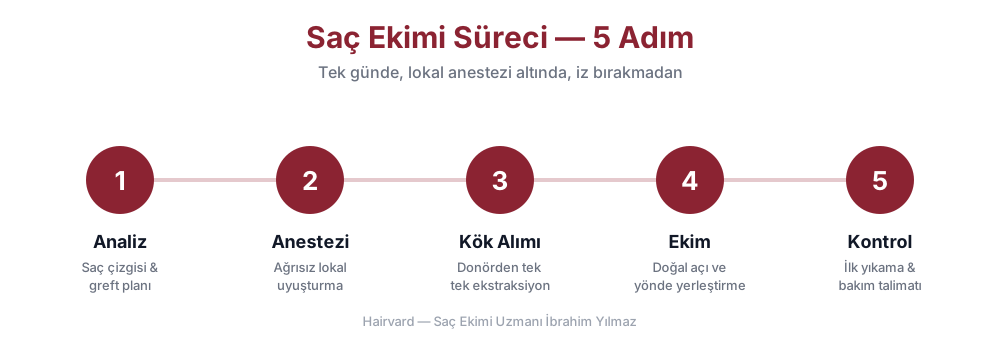
A temple transplant follows the same core stages as any modern follicular unit procedure, with extra attention to design.
During consultation and design, the surgeon studies your existing temple pattern, the direction of surviving hairs, your facial proportions, and your long-term loss outlook. The proposed shape is drawn on and reviewed with you before anything else happens.
Grafts are then harvested, most commonly by the FUE method, in which individual follicular units are extracted from the donor area at the back and sides of the scalp. Single-hair units are prioritized for the temple.
Recipient sites are created next. This is the decisive step for the temples: the surgeon makes tiny incisions at the correct flat angle and precise direction for each graft. The grafts are then placed into these sites, oriented to continue the natural sweep of the region.
| Stage | Focus for the temple | Patient experience |
|---|---|---|
| Design | Shape, symmetry, direction map | Collaborative review |
| Harvest | Select single-hair units | Local anaesthesia |
| Site creation | Flat angle, exact direction | Local anaesthesia |
| Placement | Continue natural sweep | Local anaesthesia |
| Aftercare | Protect fine grafts | Home recovery |
The procedure is performed under local anaesthesia. Most patients return home the same day with detailed aftercare instructions.
Temple Transplants in Women
Temple restoration is not a male-only concern. Women frequently seek this procedure, and their reasons often differ. Some women have naturally high or sparse temples and want to lower the temple point to soften a broad forehead. Others experience thinning at the temples from traction (for example, from tight hairstyles), from female pattern hair loss, or from changes over time.
The technical demands are, if anything, higher in women. Female temple hair is often especially fine, the desired shape tends to be softer and rounder than a masculine corner, and the density gradient must be very gentle. Preserving a feminine, oval frame rather than creating sharp corners is central to the design.
| Consideration | Men | Women |
|---|---|---|
| Common goal | Rebuild receded corners | Lower or soften a high temple |
| Preferred shape | Defined temple point | Rounded, soft edge |
| Frequent cause | Male pattern loss | Traction, high hairline, thinning |
| Density style | Feathered, graded | Very soft gradient |
Because women more often keep long hairstyles that fully expose the temple in motion, the naturalness of angle and direction is scrutinized closely, making surgeon experience especially important.
Recovery and What to Expect Over Time
Early recovery after a temple transplant is similar to other FUE procedures. Tiny crusts form around each graft and typically flake away over the first one to two weeks. Some redness and mild swelling can occur. Because the temple sits near the face, patients are advised to be gentle and to follow washing instructions carefully to protect the delicate single-hair grafts.
Transplanted hairs commonly shed within the first few weeks, which is a normal and expected phase, not a failure. New growth from the transplanted follicles generally begins to appear over the following months, with continued thickening across the first year and refinement of the final look sometimes visible beyond that. Individual timelines vary, and no specific cosmetic result can be guaranteed.
If your surgeon recommends medications such as finasteride or minoxidil to help preserve your existing non-transplanted hair, these are used only under medical supervision, with the risks and benefits discussed for your situation.
| Timeframe | Typical experience |
|---|---|
| Days 1–14 | Crusting, mild redness, careful washing |
| Weeks 2–8 | Shedding of transplanted hairs (normal) |
| Months 3–6 | Early new growth begins |
| Months 6–12+ | Progressive thickening and refinement |
Cost of a Temple Hair Transplant
Pricing depends on the number of grafts, whether one or both temples are treated, and whether the work is combined with frontal hairline or crown restoration. At our clinic, hair transplant procedures generally fall within a range of EUR 2,200 to 4,800. A temple-only case with a modest graft count sits toward the lower end, while a combined hairline-and-temple reconstruction with a higher graft count sits higher.
A precise quote is only possible after a personal assessment, because the plan is built around your donor supply, your recession pattern, and your goals. Beware of any offer that guarantees a specific result or quotes a firm price without evaluating your scalp.
Frequently Asked Questions
What causes temple recession in the first place?
The most common cause is pattern hair loss, in which the temporal corner follicles miniaturize and produce finer, shorter hairs. Other contributors include traction from tight hairstyles, a naturally high temple, and general thinning over time. A consultation helps distinguish inherited shape from progressive loss.
Why is the temple considered harder to transplant than the hairline?
Temple hair is very fine, grows as single follicles, lies almost flat against the skin, and changes direction across a small area. These features leave little margin for error and make correct angle and direction essential for a natural look.
How many grafts will I need for my temples?
Typical planning ranges run from roughly 150 to over 1,000 grafts per side depending on the extent of recession. Because both sides are usually treated for symmetry, totals often fall between about 400 and 1,800 grafts. Your exact number is set during a personal assessment.
Will a temple transplant look natural?
When single-hair grafts are placed at the correct flat angle and direction, with feathered density and an irregular edge, the result can blend seamlessly with your existing hair. Naturalness depends heavily on surgeon experience and careful design.
Can women have temple hair transplants?
Yes. Women frequently seek temple restoration to lower a high temple point, soften a broad forehead, or address thinning. The design favors rounded, soft edges and a very gentle density gradient rather than defined masculine corners.
Is the procedure painful?
The procedure is performed under local anaesthesia, so the temple area is numbed during harvesting, site creation, and placement. Mild soreness afterward is usually manageable with the guidance provided in your aftercare instructions.
How long until I see results?
Transplanted hairs typically shed within the first few weeks, then new growth generally begins over the following months, with thickening across the first year and sometimes further refinement beyond. Timelines vary between individuals, and no specific outcome can be guaranteed.
Will the transplanted temple hair fall out again?
The relocated follicles are usually taken from a donor area that is more resistant to pattern loss, so they tend to be durable. However, your original non-transplanted temple hair can continue to thin, which is why some patients are advised on maintenance under medical supervision.
Can I treat only one temple?
It is possible, but temples are usually treated together to preserve facial symmetry. Even when recession is worse on one side, the surgeon balances the design so both temples frame the face evenly.
Do I need medication after a temple transplant?
Not always. Some patients are advised to use medications such as finasteride or minoxidil to help protect existing hair, but these are only used under medical supervision after discussing the risks and benefits for your individual case.
How much does a temple hair transplant cost?
At our clinic, hair transplant procedures generally range from EUR 2,200 to 4,800, depending on graft numbers and whether the temples are combined with other zones. A precise quote follows a personal scalp assessment.
Can a temple transplant be combined with a hairline transplant?
Yes, and it commonly is. Treating the frontal hairline and the temples in the same session helps create a cohesive, natural frame and can be more efficient than separate procedures. The combined graft count and cost are planned together.
This article was medically reviewed by hair transplant specialist Ibrahim Yilmaz. For a personalized plan, Hairvard offers a free hair analysis to assess your temple recession, donor supply, and suitability for treatment.