

How AI Hair Analysis Works
Wondering whether you're a candidate for a hair transplant, but not ready to book a clinic visit yet? Hairvard Studio AI lets you start from home. You upload a few photos, and the system produces a fast, structured estimate of your situation: your approximate Norwood stage, your donor area capacity, and a rough idea of how many grafts your case might need. This is a screening tool designed to give you clarity early, at no cost. It is important to be clear from the start: the AI provides an estimate that supports our specialist, not a final medical diagnosis. Every analysis is reviewed and confirmed by our specialist, Ibrahim Yilmaz, and a definitive assessment always requires a physical examination. This article explains exactly how the photo-based analysis works, what photos you need, how long it takes, and where its limits lie.
Key Takeaways
- Hairvard Studio AI analyzes photos you upload to estimate your Norwood stage, donor density, and approximate graft need in minutes.
- The result is a preliminary estimate, not a definitive diagnosis; a physical exam by specialist Ibrahim Yilmaz is always required to confirm your plan.
- The analysis is free, fast, and done from home, so you can explore your options before committing to a consultation.
- You'll get the best estimate by uploading clear, well-lit photos from several angles (front, top, sides, and back).
- The AI supports the specialist and speeds up the early screening step; it does not replace the clinical judgment of a licensed doctor.
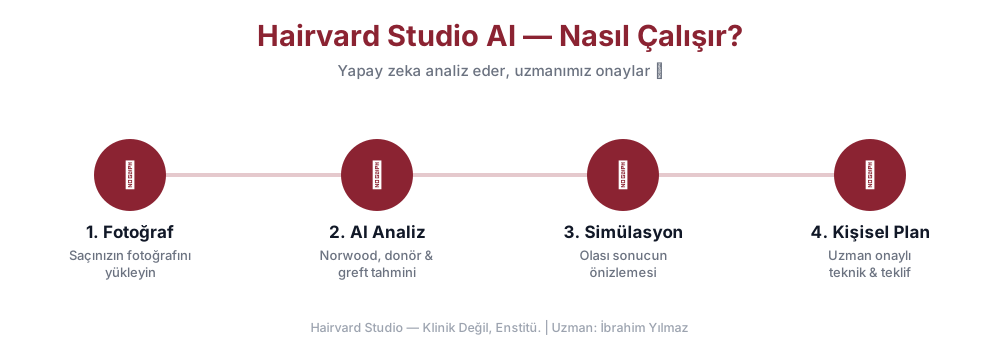
- Photo analysis is the first of four Hairvard Studio AI capabilities, connecting to result simulation, hairline design, and a personalized plan and quote.
What AI Hair Analysis Actually Does
Photo-based hair analysis is the entry point to Hairvard Studio AI. When you upload photos, the system uses computer vision to read patterns in your hair and scalp that correlate with the standard measures clinicians use every day. Instead of waiting days for a first opinion, you receive a structured summary you can act on right away.
Specifically, the AI produces three core outputs:
- Norwood stage estimate. The Norwood scale is the standard classification for male pattern hair loss, running from Stage 1 (no significant recession) to Stage 7 (extensive loss). The AI compares your hairline and crown patterns against this scale to suggest your approximate stage.
- Donor area capacity estimate. Your donor area (usually the back and sides of the scalp) is where grafts are harvested. The AI assesses the visible density of this region to estimate how much healthy hair may be available for transplantation.
- Approximate graft need. By combining the estimated area of thinning with the donor assessment, the system offers a rough range of grafts your case might involve. This is a ballpark figure to help you understand scale, not a surgical quote.
These outputs are intentionally framed as ranges and estimates. Real hair characteristics like follicular unit grouping, hair caliber, and scalp laxity cannot be fully measured from a photo, which is why specialist confirmation is essential.
How the Analysis Works, Step by Step
The process is designed to be simple enough to complete on a phone in a few minutes. Here is what happens at each stage.
| Step | What you do | What the system does | Typical time |
|---|---|---|---|
| 1. Upload photos | Take and submit photos from the required angles | Checks image quality and framing | 1–2 minutes |
| 2. Image processing | Wait while the system reads your photos | Detects hairline, thinning zones, and donor region | Under a minute |
| 3. Estimation | Review the on-screen results | Estimates Norwood stage, donor density, graft range | Near-instant |
| 4. Specialist review | Receive your reviewed summary | Ibrahim Yilmaz checks and confirms the estimate | Same day, usually |
| 5. Next steps | Explore simulation, plan, and quote options | Prepares your personalized recommendation | Varies |
The automated part of the analysis typically completes within a few minutes. The specialist review step is what turns a raw estimate into something you can trust, and it is always part of the Hairvard process. The AI never sends you a "final" plan on its own.
Which Photos You Need
Photo quality is the single biggest factor in how useful your estimate will be. Blurry, dark, or poorly angled images force the system to work with less information, which widens the estimate range. Follow the guidance below for the best result.
| Angle | Why it matters | Common mistake to avoid |
|---|---|---|
| Front (hairline) | Shows recession and frontal hairline shape | Hair pushed forward hiding the hairline |
| Top / crown | Reveals crown thinning and vertex pattern | Shot taken too far away |
| Left and right sides | Assesses temporal recession and side density | Shadows from overhead light |
| Back (donor) | Estimates donor capacity | Photo too close or out of focus |
A few practical tips:
- Use natural daylight or bright, even indoor lighting; avoid harsh shadows.
- Keep hair in its natural state (dry, not heavily styled or wet).
- Make sure the scalp is visible, especially in thinning areas.
- Take photos at a consistent distance so proportions stay accurate.
If you're unsure whether your situation is suitable for treatment at all, it can help to first read about who qualifies. Our guide on hair transplant candidates explains the general criteria, and the AI analysis then gives you a personalized starting point.
AI Analysis vs. Clinical Examination
This is the most important section for setting expectations honestly. The AI is a screening and support tool. It is genuinely useful for getting oriented quickly, but it does not and cannot replace a hands-on clinical evaluation. The table below shows where each fits.
| Aspect | AI Photo Analysis | Clinical Examination |
|---|---|---|
| Purpose | Fast preliminary screening | Definitive medical assessment |
| Basis | Photos you upload | Physical, in-person inspection |
| Norwood stage | Estimated | Confirmed |
| Donor density | Visual estimate | Measured with magnification |
| Scalp laxity | Not assessable | Directly evaluated |
| Hair caliber & grouping | Limited | Precisely assessed |
| Underlying conditions | Not diagnosed | Screened by specialist |
| Final treatment plan | Not provided | Confirmed by Ibrahim Yilmaz |
| Cost | Free | Part of full consultation |
| Speed | Minutes | Scheduled appointment |
The key takeaway: the AI gives you a well-informed estimate, and the specialist gives you a confirmed diagnosis and plan. Certain factors, such as scalp laxity, the true caliber of your hair, and any underlying scalp or medical conditions, simply cannot be judged from a photograph. That is why our specialist, Ibrahim Yilmaz, reviews every case, and why the final plan is always established through professional assessment.
What the Analysis Cannot Tell You
Being transparent about limits is part of how we work. Your AI estimate should be treated as a starting point, not a verdict. It cannot:
- Provide a definitive medical diagnosis of the cause of your hair loss.
- Detect underlying conditions (for example, certain forms of alopecia or scalp health issues) that require clinical evaluation.
- Measure scalp laxity or the mechanical properties that affect surgery.
- Guarantee a specific graft count or a specific result.
When these limits matter, the specialist steps in. Photo analysis is best understood as the fast, convenient first layer of a process that becomes more precise at every stage.
From Analysis to a Full Picture
Photo analysis is only the beginning of what Hairvard Studio AI offers. Once you have your estimate, you can move on to visualizing potential outcomes. The hair transplant result simulation generates an estimated preview of how a treatment might look, so you can picture the direction before making decisions.
It is important to keep the honest framing here too: a simulation is an estimated visualization, not a promise. Real results vary from person to person based on individual healing, hair characteristics, and how a case progresses. The preview is a communication and planning aid, reviewed alongside the specialist's input, not a guaranteed outcome.
Together, the four capabilities, analysis, simulation, hairline design, and a personalized technique recommendation with plan and quote, form a connected journey. Each step adds detail, and each is grounded in specialist confirmation rather than replacing it.
Understanding Your Estimate Responsibly
When you read your results, keep a few principles in mind. First, an estimate expressed as a range is not a weakness; it is an honest reflection of what a photo can and cannot show. Second, a higher estimated Norwood stage does not automatically rule you out, and a lower one does not automatically guarantee a simple case. Individual factors matter, and those are exactly what the specialist evaluates. Third, the graft range you see is designed to help you understand scale and rough budget, not to lock in a number.
For context, hair transplant treatment at Hairvard falls within a typical range of EUR 2,200 to 4,800, depending on the specifics of your case. The AI estimate helps you see roughly where you might sit within that range, while the confirmed quote comes after specialist review. The initial photo analysis itself is free, so you can get oriented before any financial commitment.
Frequently Asked Questions
How long does the AI hair analysis take?
The automated analysis of your photos typically completes within a few minutes. After that, specialist Ibrahim Yilmaz reviews your case, which is usually completed the same day, so you receive a confirmed summary rather than an unreviewed machine output.
Is the AI hair analysis really free?
Yes. The photo-based analysis is offered free of charge as a way to help you understand your situation before deciding on next steps. There is no obligation to proceed with treatment.
How accurate is the AI estimate?
The AI provides a useful preliminary estimate, but it is not a definitive diagnosis. Accuracy depends heavily on photo quality, and some factors (like scalp laxity and hair caliber) cannot be judged from images at all. The specialist's confirmation is what makes your assessment reliable, which is why we do not publish a single accuracy percentage.
Can the AI replace a doctor's examination?
No. The AI supports the specialist; it does not replace one. A definitive diagnosis and your final treatment plan always require a physical examination and are confirmed by Ibrahim Yilmaz.
What photos do I need to upload?
You'll get the best estimate with clear, well-lit photos from several angles: the front (hairline), the top/crown, both sides, and the back (donor area). Natural lighting and a visible scalp make a big difference.
Will my graft estimate be exactly what I need for surgery?
Not exactly. The graft figure is a rough range to help you understand the scale of your case. The precise number is determined during clinical assessment, where the specialist evaluates factors a photo cannot capture.
Does the AI diagnose the cause of my hair loss?
No. The AI estimates patterns associated with hair loss, but it does not diagnose underlying conditions. If there is a medical cause that needs attention, that is identified through specialist evaluation, not by the photo analysis.
What if my photos are low quality?
Poor lighting, blur, or awkward angles reduce how much the system can read, which widens your estimate range. If your photos are unclear, you may be asked to retake them. Following the photo guidance above gives you the most useful result.
Is my Norwood stage estimate final?
No. The Norwood stage from the AI is an estimate based on your photos. It is confirmed (or adjusted) during specialist review, since an in-person look can reveal detail that images miss.
What happens after I get my analysis?
You can explore the result simulation to preview potential outcomes, review hairline design options, and receive a personalized technique recommendation with a plan and quote, all reviewed and confirmed by the specialist before anything is finalized.
Can I do the whole analysis from home?
Yes. Uploading your photos and receiving your estimate is designed to be done entirely from home, on your own device. It is a convenient first step before any clinic visit.
Is a hair transplant right for me based on the AI result alone?
The AI result is a helpful indicator, but suitability is confirmed by the specialist. To understand the general criteria, read our guide on hair transplant candidates, then let the AI analysis and specialist review personalize the picture for you.
This article was reviewed and confirmed by Ibrahim Yilmaz, hair transplant specialist at Hairvard, Atasehir/Istanbul, licensed by the Turkish Ministry of Health. The information here is educational and does not replace a personal medical assessment. Ready to begin? Start your free photo-based hair analysis with Hairvard Studio AI from home, or call us at +90 530 378 74 87 to ask any questions. Your estimate is the first step; our specialist confirms the rest.